 Helen Santos
On August 3, 2026, a Fox News segment showed a UK tactical coach demonstrating a simple chair-based fitness test and calling it a direct window into how long you’ll live. The clip went viral almost immediately. And for once, the hype isn’t outrunning the science.
The test in question, the 30-second sit-to-stand, has been circulating in clinical settings for years. What’s changed is the weight of evidence now backing it up. A 2026 review by Castro-Piñero et al., published on ResearchGate in May, formally designated the sit-to-stand test as “a powerful prognostic factor of future health outcomes” across multiple assessment versions. That’s not marketing language. That’s a peer-reviewed conclusion about a test you can do in your living room.
Most mainstream coverage stops at “this test predicts your lifespan, try it!” and never explains why the test works, what a score actually means, or how to move the needle. That’s the gap worth closing.
- Each 6-second improvement in chair-stand time links to a 9% lower mortality risk (JAMA Network Open, 2026).
- Adults scoring lowest on the sitting-rising test were nearly 4x more likely to die overall vs. those scoring a perfect 10.
- The 30-second sit-to-stand counts how many full stands you complete; norms vary by age and sex.
- Grip strength and chair-stand speed together predict mortality risk better than either measure alone.
- You can meaningfully improve your score in 8–12 weeks with targeted lower-body and balance training.
What the Test Actually Measures (and Why It’s Not Just Leg Strength)
Here’s what most articles miss: standing up from a chair is not a simple movement. It requires coordinated strength from your quadriceps, glutes, and core; adequate hip and ankle mobility; and balance control sophisticated enough to shift your center of mass forward without falling. When any of those systems starts degrading, the movement gets slower, shakier, or impossible.
The 30-second sit-to-stand test captures that whole chain at once. You sit in a standard chair, arms crossed over your chest, and count how many full stands you complete in 30 seconds. It’s a rate-of-force-production measure, not just a strength test. Slow-twitch endurance, fast-twitch recruitment, and neuromuscular coordination all show up in the score.
A March 2026 Harvard Health report, summarizing findings from a JAMA Network Open study of 5,400+ women ages 63 and older followed for eight years, found that each 6-second improvement in chair-stand time was associated with a 9% lower risk of death. That’s a specific, meaningful number tied to a movement you can literally practice tomorrow.
What Your Score Actually Means
Scoring norms matter. Completing 12 stands in 30 seconds means something very different at 65 than at 80. Here’s how the widely-used Jones and Rikli normative data (the standard reference in functional fitness testing for older adults) breaks down by age group for women and men:
| Age Group | Below Average (Women) | Average (Women) | Below Average (Men) | Average (Men) |
|---|---|---|---|---|
| 60–64 | fewer than 12 | 12–17 | fewer than 14 | 14–19 |
| 65–69 | fewer than 11 | 11–16 | fewer than 12 | 12–18 |
| 70–74 | fewer than 10 | 10–15 | fewer than 12 | 12–17 |
| 75–79 | fewer than 10 | 10–15 | fewer than 11 | 11–17 |
| 80–84 | fewer than 9 | 9–14 | fewer than 10 | 10–15 |
Scoring below average for your age group doesn’t mean you’re doomed. It means you’ve identified a specific, trainable weakness before it becomes a fall, a hospitalization, or worse.
The sitting-rising test, a related but distinct assessment where you lower yourself to the floor and rise without using hands or knees, adds another layer. A June 2025 study in the European Journal of Preventive Cardiology found that adults ages 46–75 who scored lowest on that test were nearly four times more likely to have died overall and six times more likely to have died of cardiovascular causes compared to those who scored a perfect 10, after a 12-year follow-up. Six times. That’s not a marginal difference.
The Grip Strength Connection You Shouldn’t Ignore
Chair-stand speed rarely travels alone. The same 2026 JAMA Network Open study found grip strength independently predicted mortality in older women, with each 7-kilogram increase in grip strength associated with a 15% lower risk of death. Grip and chair-stand performance tend to move together because they’re both downstream signals of overall musculoskeletal health, not isolated party tricks.
This matters for training. If your chair-stand score is low, odds are good your grip strength is also lagging. Both respond to the same general intervention: progressive resistance training, consistently applied. One without the other is incomplete.
How to Actually Improve Your Score
The ACSM ranked “Fitness Programs for Older Adults” as the number two overall trend in its 2026 Worldwide Fitness Trends report, based on a survey of 2,000 fitness professionals. That ranking reflects where institutional attention is going. It also means more qualified trainers are now equipped to work specifically with this population than at any point in the past decade.
What works for improving sit-to-stand performance, based on the evidence:
Goblet squats and box squats train the exact movement pattern of standing, with controllable load. Box squats, where you squat to a set height and pause before standing, are particularly useful because they eliminate momentum. Momentum is what hides weakness.
Eccentric-focused movements build the deceleration strength needed to sit down slowly and safely. Most people can stand up reasonably well; the controlled descent is where neuromuscular gaps show up.
Heel raises and single-leg stance work build ankle stability and balance, the components that don’t show up in a straight strength test but absolutely show up in your sit-to-stand score.
Progressive overload matters. Doing the same bodyweight squat routine for months doesn’t keep improving the score. Adding resistance, reducing support, or increasing range of motion is what drives continued adaptation. A certified trainer or physical therapist can help you determine the right progression given your current baseline, especially if you have existing joint issues.
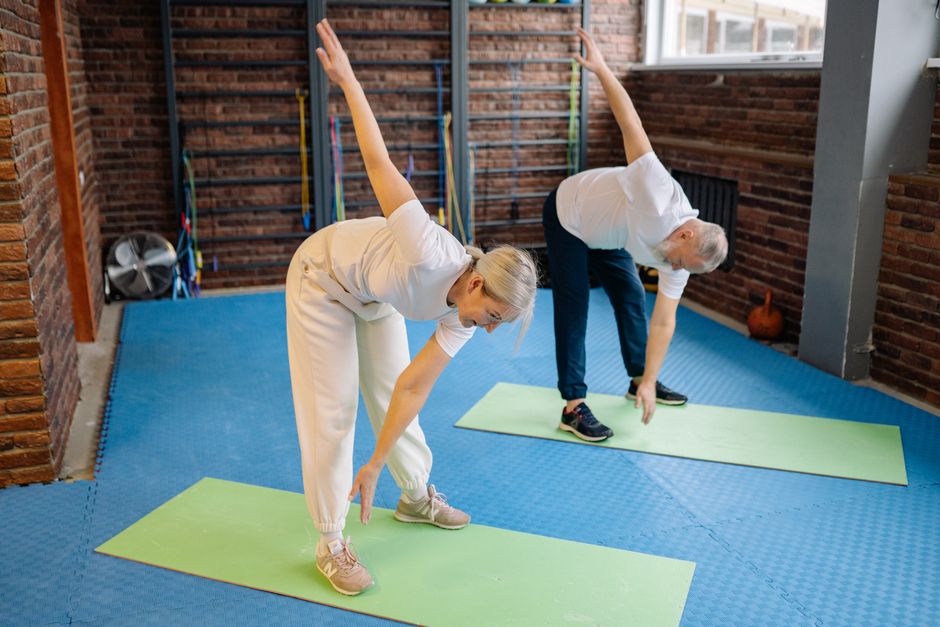
Aim for 2 to 3 sessions per week of targeted lower-body resistance work. Eight to twelve weeks of consistent training typically produces measurable improvement in chair-stand scores. That improvement, according to the research, isn’t just athletic. It’s biological risk reduction.
The Test Is a Starting Point, Not a Verdict
A viral Fox News clip will get people to try the test once. What it won’t do is explain that the score is a snapshot, not a sentence. The body responds to training at 65, at 72, at 80. Sarcopenia, the age-related loss of muscle mass, accelerates from roughly age 60 onward, but it’s not irreversible. That’s the part most coverage buries at the bottom, if it mentions it at all.
Take the test. Know your number. Then treat it as information about where to put your effort, not a fixed prediction about how your story ends. And if you’re significantly below average for your age group, or if you have balance, cardiovascular, or orthopedic concerns, get a professional assessment before ramping up training intensity. The goal is more years with capable, confident movement. Nothing about that goal is passive.
Sources
- Stronger Muscles After Age 60 Linked to Longevity (March 2026)
- This Simple Strength Test Could Predict How Long You Live (May 2026)
- What the Sitting-Rising Test Says About Your Health (October 2025, updated)
- Sit-to-Stand Test as a Prognostic Factor, Castro-Piñero et al. (May 6, 2026)
- Adults Over 60 Should Try One 30-Second Test to Predict Healthy Aging (August 3, 2026)
- 2026 ACSM Worldwide Fitness Trends (Late 2025 / active July 2026)
Photo: RDNE Stock project via Pexels
This article is for general informational purposes only and does not constitute medical or fitness advice. Consult your physician or a licensed physical therapist before starting a new exercise program, especially if you have existing health conditions.