 Helen Santos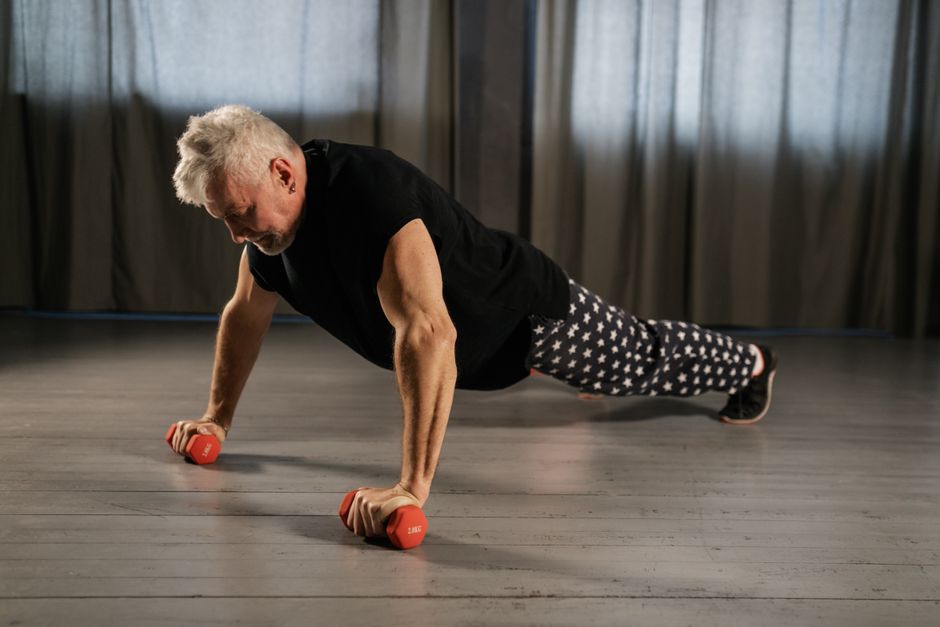
Most fitness content aimed at seniors is either patronizing or reckless. It’s either “gentle chair exercises for beginners!” with stock photos of smiling people holding two-pound weights, or it’s generic bodybuilding advice with zero acknowledgment that a 68-year-old recovering from a hip replacement isn’t the same as a 30-year-old starting a bulk. The truth sits in the middle, and it’s more interesting than either extreme.
Dumbbells, specifically, are one of the best tools available for building strength after 60. Not resistance bands, though they have their place. Not machines, despite what every commercial gym will tell you. Dumbbells work because they demand your stabilizer muscles to engage, they adjust to your exact capacity on any given day, and you can use them at home without a $90-a-month membership. That independence matters more than most trainers admit.
Here’s what else matters: sarcopenia, the gradual loss of muscle mass that begins around age 30 and accelerates after 60, is not inevitable. A 2021 study in the Journal of Cachexia, Sarcopenia and Muscle found that progressive resistance training remains effective at building lean mass well into the eighth and ninth decades of life. “Effective” isn’t vague encouragement. It means measurable increases in muscle cross-sectional area, grip strength, and functional mobility. You’re not fighting a losing battle. You’re fighting a winnable one.
Why Most Dumbbell Advice for Seniors Gets the Starting Point Wrong
Everyone tells you to start light. That advice isn’t wrong, but it’s incomplete in a way that causes real problems.
Starting too light and staying too light is one of the most common mistakes I see. A reader named Patricia emailed me a few months ago: she’d been doing 3-pound dumbbell curls for two years after seeing them recommended in a senior fitness pamphlet. She wasn’t getting stronger, wasn’t sleeping better, and frankly was bored out of her mind. When we recalibrated her to 10-pound curls for sets where she genuinely fatigued by rep 12, she noticed a difference within six weeks. Not dramatic. But real.
The principle at work is called progressive overload. Your muscles only adapt when you give them a reason to. If the last three reps of a set don’t feel challenging, the weight isn’t doing its job. That threshold is different for everyone, and it changes over time as you get stronger.
Here’s how to find your starting weight: pick up a dumbbell and perform 15 slow, controlled reps of a curl. If you finish the 15th rep and could easily do 10 more, go heavier. If you can’t complete 10 reps with good form, go lighter. You’re looking for a weight where reps 12 through 15 require genuine effort but your form doesn’t collapse. That’s your working weight.
For most beginners over 60, this lands somewhere between 8 and 20 pounds for lower-body movements and 5 to 15 pounds for upper-body work. But those numbers are loose. Ignore anyone who gives you a single universal weight recommendation.
The Exercises That Actually Move the Needle
A lot of popular senior dumbbell routines include exercises that provide little functional benefit while taking up time that could go toward movements that transfer to real life. Wrist curls, for instance. Standing alternating shoulder raises done with the weight of a small sandwich. Skip those.
The movements worth your time are the ones that mirror what your body needs to do every day: get up from a chair, carry groceries, catch yourself if you stumble, reach overhead. Build your program around these.
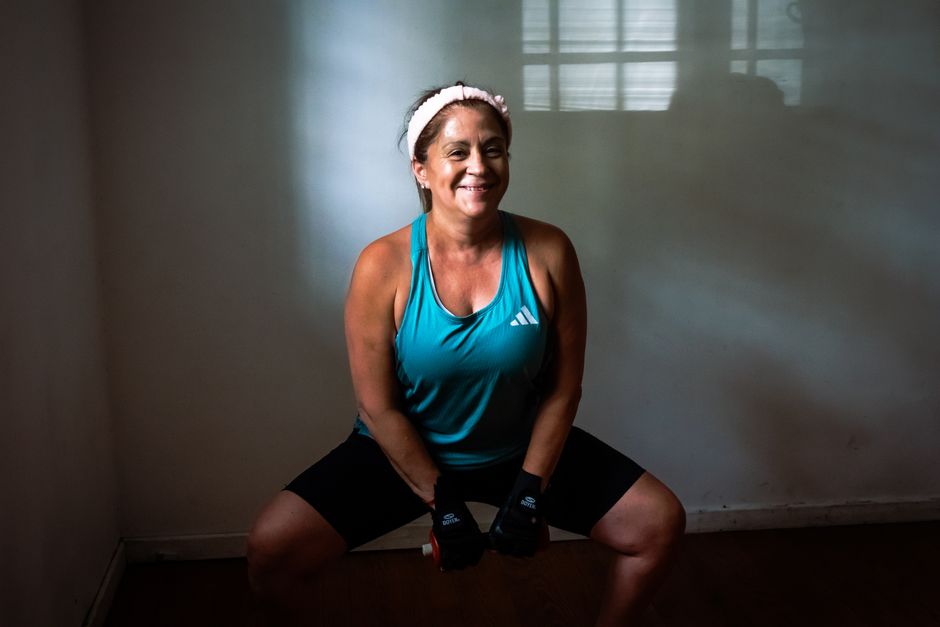
The goblet squat is probably the single most valuable exercise in this category. Hold one dumbbell vertically at your chest (the “goblet” position), feet shoulder-width apart, and squat until your thighs are roughly parallel to the floor, or as low as your knees and hips comfortably allow. The dumbbell acts as a counterbalance, which actually makes this easier on the lower back than a barbell squat while still loading the quads, glutes, and core. If you can only do this to a shallow depth right now, a sturdy chair behind you for confidence is completely fine.
Romanian deadlifts are what I’d call the sleeper pick. Most seniors never do them because “deadlift” sounds like something for 25-year-olds at powerlifting meets. But a Romanian deadlift with two 15-pound dumbbells is just a hip hinge: stand tall, push your hips back while lowering the weights along your thighs, feel the stretch in your hamstrings, then drive your hips forward to stand. That movement pattern, hip hinging under load, directly builds the posterior chain strength that prevents lower back pain and keeps you from crumpling when you pick something heavy off the floor.
The single-leg Romanian deadlift deserves a mention because balance is where many people over 60 are most vulnerable. A 2019 review in Age and Ageing identified poor single-leg stability as one of the strongest predictors of fall risk in older adults. This variation, holding one dumbbell and balancing on one foot, is genuinely hard. Start without weight, hold a wall or counter if needed, and work your way toward holding even a 5-pound dumbbell. The neural training alone is worth it.
Dumbbell rows (bent-over or supported on a bench) address the upper back, which becomes chronically weak in people who spend a lot of time seated or driving. Weak upper back contributes to the forward-head posture that makes so many older adults look like they’re perpetually checking their phones. Three sets of rows per week does more for posture than any number of stretches.
Overhead press earns its place if your shoulder health permits. Pressing overhead builds the rotator cuff and deltoid strength needed to reach upper shelves and lift carry-on bags. If you have a history of shoulder impingement, a neutral-grip “Arnold press” variation puts less stress on the joint. Worth discussing with a physical therapist before you load up.
Two movements I’d deprioritize early on: chest flyes (high torque on the shoulder at a vulnerable angle) and behind-the-neck anything. Neither is worth the risk when better options exist.
Programming: What a Real Week Looks Like
To Build Muscle After 60, You Must Do THIS · Dr. Dave Candy - Physical Therapist on YouTube
Most articles wave their hands and say “train two to three times per week.” That’s true but useless without structure.
Here’s a sustainable starting framework for most adults over 60 who are new or returning to strength training:
Two sessions per week, at least 48 hours apart. Each session covers the full body. Three to four exercises per session, three sets each, 10 to 15 reps per set. Rest 60 to 90 seconds between sets. Total time: 30 to 45 minutes. Resist the urge to add more in the first two months.
The limiting factor early on isn’t muscle capacity, it’s connective tissue (tendons and ligaments), which adapts more slowly than muscle and is where most overuse injuries happen. I’ve watched people blow past sensible starting volumes because they felt great and wanted to do more, and then spend six weeks nursing a shoulder or knee. Going slow in month one is not wasted time.
After eight to twelve weeks, you can add a third weekly session or introduce a split where you train upper body and lower body on separate days. By that point you’ll have enough body awareness to read your own fatigue signals, which matters more than any generic progression table.
Rest days are not optional. Muscle is built during recovery, not during training. If you’re sore two days after a session, that’s a signal to wait one more day, not push through.
Equipment: What’s Worth Buying and What Isn’t
You don’t need much.
A set of fixed dumbbells in three weights (light, medium, heavy for you) covers most needs. Something like a 10-pound, 15-pound, and 20-pound set from Amazon or Walmart runs roughly $60 to $100 and lasts a lifetime. Rubber hex dumbbells are worth the marginal cost over chrome because they don’t roll across the floor when you set them down. This sounds trivial until you’ve watched someone step on a rolling dumbbell.
Adjustable dumbbells like the Bowflex SelectTech 552s (currently around $350 for the pair) are genuinely convenient if you’re tight on space. The mechanism works well and they adjust from 5 to 52.5 pounds in 2.5-pound increments. Honestly worth the price if you’re committing to this long-term.
What you don’t need: a bench (the floor or a sturdy chair works for most supported exercises), gloves (they reduce grip strength over time, counterproductively), or any kind of lifting belt to start. A non-slip mat for floor exercises is $25 and genuinely useful.
One purchase I do recommend: a full-length mirror if you don’t have one. Watching your own form isn’t vanity. It’s safety. Video feedback from your phone propped against a wall works too.
The truth about dumbbell training for adults over 60 is that it’s less complicated than the fitness industry wants you to believe, and more effective than the overly cautious crowd will admit. Pick the right movements. Add load progressively. Recover between sessions. The rest is mostly noise.
Photo: Alena Darmel via Pexels
This article is for general informational purposes only and does not constitute medical or fitness advice. Consult your physician or a licensed physical therapist before starting a new exercise program, especially if you have existing health conditions.
Sources
- Alena Darmel
- Nutramax Cosequin Senior Dog Soft Chews (60ct)
- Nutramax Cosequin DS Joint Supplement for Dogs (132ct)
- in the *Journal of Cachexia
Disclosure: As an Amazon Associate, we earn a small commission from qualifying purchases at no extra cost to you. We only recommend products that genuinely support the topics covered in this article.
- Nutramax Cosequin Senior Dog Soft Chews (60ct) (~$32), Senior-specific Cosequin formula with added Omega-3s, designed for aging dogs with joint and immune health needs.
- Nutramax Cosequin DS Joint Supplement for Dogs (132ct) (~$36), The #1 veterinarian-recommended joint supplement brand, clinically studied for reducing joint pain in dogs.