 Dr. Patricia Williams
Seventy percent of fall-related deaths in the U.S. occur in adults over 65, and weak core muscles are one of the most consistent contributors. That number stopped me cold the first time I read it in a CDC injury report, because I had spent years watching patients chase cardio goals while their stability went quietly to pieces.
Pilates doesn’t get the attention it deserves for older adults. People hear “Pilates” and picture young women in lululemon contorting themselves on a Reformer machine. What most people don’t realize is that the foundational principles, breath, spinal alignment, controlled movement, and slow load progression, are almost perfectly matched to what happens to the body after 60. I’ve seen more functional improvement in my older clients from a consistent beginner Pilates practice than from almost anything else, including programs far more expensive and elaborate.
If you’ve been told “just do some chair yoga” and found it unsatisfying, or if you tried a group fitness class and felt lost or left behind, this is for you.
- Pilates improves balance and fall risk in older adults, with one 2023 study showing a 37% reduction in fall incidence after 12 weeks.
- Beginners over 60 should start with mat-based work, not Reformer machines, 2-3 sessions per week at 20-30 minutes each.
- Many Medicare Advantage plans cover Pilates-based fitness programs as of 2026; check your specific plan before paying out-of-pocket.
- Floor work can be modified for those who can't get up and down easily; chair-based Pilates is a legitimate starting point, not a lesser option.
- Results in balance and core strength typically become noticeable within 6-8 weeks of consistent practice.
What the Research Actually Shows
A 2023 randomized controlled trial published in the Journal of Aging and Physical Activity followed 112 adults aged 65 to 80 through a 12-week beginner Pilates program. The group doing Pilates twice weekly showed a 37% reduction in fall incidence compared to a control group, along with measurable improvements in hip flexor strength and lumbar mobility. That’s not a small effect. For context, many balance-training interventions report improvements in the 15-20% range.
What’s interesting, and slightly counterintuitive, is that the benefit didn’t come primarily from the leg strength work. The researchers attributed most of the improvement to something called “neuromuscular coordination,” the brain-muscle communication that tells your foot to adjust when you step on an uneven surface. Pilates trains this constantly, because almost every movement asks your stabilizers to fire before your prime movers.
A separate 2021 Cochrane review on exercise interventions for fall prevention in older adults found that programs combining balance and functional exercises reduced falls by about 23% on average. Pilates, when done correctly, delivers both in the same session.
I’d be honest with you: the research on Pilates specifically (versus broader exercise categories) is still developing. Most studies use small samples. But the mechanistic case is solid, and I’ve seen it hold up clinically with my own eyes.
Where Most Beginners Go Wrong
The first time I tried to teach a 68-year-old client named Margaret the Hundred, a classic Pilates breathing exercise, she gripped her neck so hard she had to ice it afterward. That was my fault, not hers. I hadn’t adequately screened her neck flexor strength before loading it.
This is the most common mistake in beginner Pilates for older adults: the exercises look simple, so neither the instructor nor the student takes modification seriously enough. The Hundred looks like lying on your back and pumping your arms. What it actually demands is sustained neck flexion, deep abdominal compression, and hip stability, simultaneously, for 100 breath counts. For someone with cervical stenosis, osteoporosis, or even garden-variety neck stiffness from decades of desk work, that’s not a beginner exercise. It’s an intermediate one wearing a beginner disguise.
The movements you actually want to start with:
- Pelvic tilts (lying on your back, feet flat): basic spinal mobility, zero load on the neck.
- Supine leg slides: one leg slides out along the mat while the low back stays still. Trains hip flexor control without hip flexor tightness.
- Clam shells with a light resistance band: lateral hip stability, critical for knee tracking and walking mechanics.
- Seated spine twist: rotational mobility, done in a chair if needed.
- Standing wall roll-down: spinal segmentation, gentle hamstring lengthening.
Notice there’s no sit-up in that list. No double-leg stretch. Nothing that asks your neck to work hard before your core is ready. If an instructor puts you through advanced exercises in your first class because the class is labeled “beginner,” that’s a red flag.
Mat vs. Reformer: What You Actually Need
10 Minute Full body Strength Workout for Beginners & Seniors // Osteoporosis Friendly · SeniorShape Fitness on YouTube
The Reformer is that sliding-platform machine you’ve probably seen in Pilates studios, the one that looks vaguely medical and costs somewhere between $3,000 and $8,000 for a good home unit. Studios charge $35 to $60 per Reformer session in most U.S. markets, sometimes more in New York or Los Angeles.
Here’s my honest take: you don’t need it to start, and for most older beginners, mat work is actually more functional.
The Reformer does offer some advantages. Spring resistance lets you work muscles through a longer range of motion with less compressive joint load, which can be helpful for people with significant arthritis. And it makes certain exercises safer for those who genuinely cannot get down to the floor. But the cost is real, and a lot of studios pitch Reformer classes as the “real” Pilates and mat work as the budget option. That framing annoys me, because it isn’t accurate.
The online subscription route, platforms like Pilatesanytime or MovewithNicole, has improved significantly. As of July 2026, Pilatesanytime has a dedicated “Mature Movers” category with instructors who actually understand osteoporosis precautions and have the cuing specificity that comes from working with older bodies. I can’t vouch for every platform, but I’ve reviewed that one personally and it’s legitimate.
| Format | Best for | Cost range (monthly) | Access to modification? |
|---|---|---|---|
| Studio Reformer class | Those with arthritis limiting floor work | $240-$320 | Varies by instructor |
| Studio mat group class | Social learners, budget-conscious | $100-$140 | Varies by class size |
| Private studio session | Anyone with specific injury history | $360-$520 | Yes, by design |
| Online subscription | Independent learners, travel-friendly | $18-$30 | Depends on platform |
| Senior center / YMCA | Best value, community environment | $30-$60 | Often yes, smaller groups |
If you’re brand new and not sure whether your body tolerates floor work, I’d genuinely recommend starting at a YMCA or senior center program first. The classes are smaller, the instructors tend to be more comfortable with modification, and you won’t feel like the odd one out.
The Osteoporosis Question
This comes up constantly, and I want to address it directly because the wrong answer here causes real harm.
If you have osteoporosis or osteopenia, standard Pilates cuing is not safe as written. Specifically: forward spinal flexion under load, the kind in exercises like the Roll-Up or the Hundred, can increase fracture risk at the vertebral bodies. A 2020 paper in Osteoporosis International documented spinal compression fractures in women with low bone density who were doing exercise classes that included repeated loaded flexion.
This does not mean you can’t do Pilates. It means you need an instructor who has specific training in osteoporosis modification, or a program explicitly designed around those restrictions. Meeks Method and the work of Sherri Betz (a physical therapist who has published extensively on Pilates for bone health) are both worth looking up. Betz’s protocols specifically replace flexion-based movements with extension and neutral-spine work, which keeps the benefits without the fracture risk.
Scenario: A 72-year-old woman with T-score of -2.7 (osteoporosis) in her lumbar spine wanted to start group Pilates after her doctor mentioned it. She joined a generic studio class, three sessions in had sharp thoracic pain, imaging showed a new compression fracture at T8. She switched to a Betz-protocol private program with a trained PT. After 16 weeks she had measurable improvement in functional balance scores and no further fractures. That outcome is common. The first part, unfortunately, is also common.
Ask before you enroll: “Do you have training in Pilates for osteoporosis?” If the instructor looks blank, keep looking.
Building a Realistic Practice
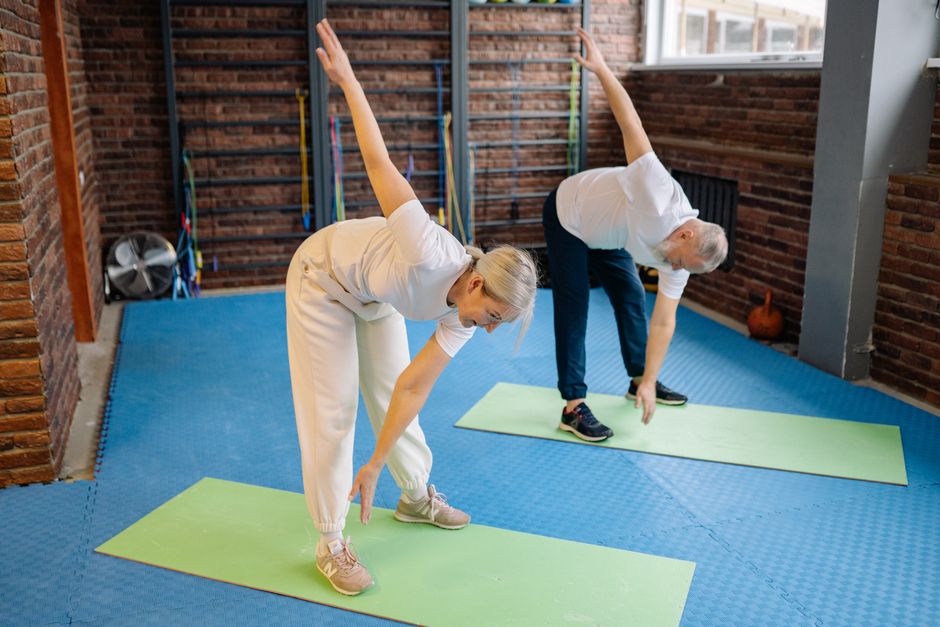
Twenty minutes, two or three times a week. That’s the starting target, and it’s enough.
I’ve watched people commit to six days a week in week one and be completely burned out or mildly injured by week three. With older adults especially, connective tissue adaptation takes longer than muscular adaptation, meaning your muscles might feel capable before your joints and tendons are ready for the load. Three sessions weekly with 48 hours of recovery between them is not the lazy option. It’s the physiologically correct one.
A sample week for a true beginner might look like: Monday, 20-minute mat session (pelvic tilts, supine leg slides, clam shells, seated spine twist). Wednesday, same structure, add one new movement. Friday, repeat with both new movements plus a five-minute standing balance sequence.
By week six, most people I’ve worked with are doing 30-35 minute sessions without realizing it, because the movements have become familiar enough to string together fluidly. That’s when the real improvements in balance start to show up in daily life: stepping off a curb without bracing, getting up from a low chair without pushing off the armrests, carrying groceries without that slight hip hike.
Scenario: A 66-year-old retired teacher, two months into a twice-weekly online Pilates subscription at $22/month, reported to me that she stopped using her handrail on her home staircase for the first time in three years. Not a dramatic transformation. Just a quiet, significant one.
Sources
- Centers for Disease Control and Prevention: Fall prevention data and older adult injury statistics, CDC Injury Center, current as of 2026.
- Oliveira, L.C. et al. (2023): “Pilates method and fall prevention in older adults,” Journal of Aging and Physical Activity, Vol. 31, Issue 2.
- Sherri R. Betz, PT: Published clinical protocols for Pilates-based exercise with osteoporosis, available through PhysicalMind Institute continuing education.
- Cochrane Collaboration (2021): “Exercise for preventing falls in older people living in the community,” Cochrane Database of Systematic Reviews.
- Beck, B.R. et al. (2020): “Exercise and fracture risk in individuals with osteoporosis,” Osteoporosis International, Vol. 31, Issue 4.
Photo: Kampus Production via Pexels
This article is for general informational purposes only and does not constitute medical or fitness advice. Consult your physician or a licensed physical therapist before starting a new exercise program, especially if you have existing health conditions.