 Dr. Patricia Williams
Most people assume the biggest threat to independence as you age is heart disease or memory loss. I’d argue it’s actually losing the ability to get up off the floor.
That might sound dramatic, but hear me out. Lower body strength is the single most direct predictor of whether an older adult will live independently at 75, 80, or 85. Not cognitive scores. Not cardiovascular fitness (though that matters too). The muscles in your hips, thighs, and calves are what allow you to stand from a chair without using your arms, catch yourself when you stumble, climb stairs without gripping the railing like it owes you money. When those go, everything else follows faster than most people expect.
I’ve been working with adults over 60 for more than fifteen years now, and I’ll be honest: the standard advice out there on this topic ranges from mildly unhelpful to genuinely dangerous. “Do chair exercises.” “Walk more.” “Take a water aerobics class.” Fine, but that’s not a strength program. That’s maintenance at best, and for someone who’s already lost meaningful muscle mass, it’s barely keeping pace with the decline.
What I want to do here is give you the real picture: which exercises actually build lower body strength in older adults, how to do them safely, and what the research actually says versus what gets repeated because it sounds reassuring.
Why Lower Body Strength Declines Faster Than You Think
| Age Group | Muscle Loss Rate (Sedentary) | Research Source |
|---|---|---|
| 60s | 1-2% per year | Journal of Gerontology |
| 70+ | 2-4% per year | Journal of Gerontology |
Here’s something that surprised me when I first dug into the physiology: muscle loss after 60 isn’t linear. It accelerates. The research on sarcopenia (age-related muscle loss) consistently shows that the rate of decline roughly doubles between your 60s and your 70s if you’re not doing targeted resistance training. A landmark paper published in the Journal of Gerontology found that adults who were sedentary lost an average of 1-2% of lower body muscle mass per year in their 60s, jumping to 2-4% per year after 70.
The lower body takes the hardest hit for a few reasons. One, it’s the furthest from your heart. Two, the fast-twitch muscle fibers responsible for power and quick reactions atrophy disproportionately with age. And three, most people reduce walking distances before they reduce arm activities, so the legs get less daily stimulation without anyone really noticing.
What this means practically: by the time someone tells me their balance has gotten “a little shaky,” they’ve often already lost 15-20% of their functional lower body strength. That’s not a rounding error. That’s the difference between catching yourself on a slippery floor and falling.
The Exercises That Actually Move the Needle
Let me be specific here, because generic lists don’t help anyone.
Sit-to-Stand (Chair Squats)
This is the single most functional exercise I prescribe, bar none. Not because it’s easy (done correctly, it’s genuinely hard), but because it directly trains the exact movement pattern that determines whether you can get up from a chair, a toilet, or the floor without help.
The technique matters enormously. Most people cheat by rocking forward aggressively and using momentum. That feels like a workout but it’s mostly hip flexors doing the work, not the quadriceps and glutes you’re trying to build.
Here’s what it should look like: sit toward the front edge of a sturdy chair, feet hip-width apart and pulled back slightly under the knees. Cross your arms over your chest (removing the option to push off the armrests). Lean forward from the hips (not the waist), then stand by pushing through your heels. The lean forward is correct and important. Pause at the top for a full second. Then lower yourself back down slowly, taking 3-4 seconds on the descent. That slow lowering (the eccentric phase) is where a lot of the muscle-building stimulus actually lives.
Start with a higher chair or firm cushion if needed. Work toward 3 sets of 10. When that becomes easy without any arm push-off, try a lower surface.
Heel Raises (Standing Calf Raises)
I undervalued these for years. I’m admitting that plainly. I thought of calf raises as cosmetic, a vanity exercise for younger clients. What changed my mind was reading the research on ankle proprioception and fall prevention. A 2020 study in Age and Ageing found that calf strength and ankle stability were among the strongest predictors of balance recovery in adults over 65. Your calves are your first line of defense when your weight shifts unexpectedly.
Stand behind a sturdy chair, hands resting lightly on the back (not gripping). Rise onto the balls of your feet as high as you can, hold for two seconds, then lower slowly. Do 15-20 reps. If you can do 20 bilaterally without effort, try single-leg heel raises. That progression is humbling for most people, myself included the first time I really tested my own balance here.
Step-Ups
A box or bottom stair step works fine. Step-ups are essentially a single-leg squat with a built-in safety catch, which makes them both more functional than regular squats and easier to scale for people with knee concerns.
Place your right foot fully on the step. Push through that heel to stand up, bringing the left foot up to tap the step before stepping back down. The key is pushing through the front (stepping) leg rather than pushing off the back leg. Start with a 4-6 inch step height. Work up to 8 inches. Hold light dumbbells (2-5 lbs) once the movement feels stable.
Three sets of 8 per leg, twice a week. Concrete example: a 68-year-old client of mine (former nurse, had been sedentary for about four years post-retirement) started step-ups at 4 inches in October and was comfortably working with a 7-inch step and 3 lb dumbbells by December. Her score on the Berg Balance Scale, a standardized clinical balance assessment, went from 42/56 to 50/56 in that same period. That’s clinically meaningful progress.
Glute Bridges
Floor-based, which some clients resist at first (partly because getting down is its own challenge). But glute bridges are irreplaceable for hip extensor strength, which is directly tied to climbing stairs, recovering from a stumble, and getting up from a low seat.
Lie on your back, knees bent, feet flat on the floor about hip-width apart. Press through your heels and lift your hips until your body forms a straight line from knees to shoulders. Squeeze your glutes at the top for two seconds. Lower slowly. If getting to the floor is difficult, a firm exercise mat and a plan for getting back up (rolling to the side, pushing up to hands and knees) takes the anxiety out of it. Start with 2 sets of 12. Progress by adding a 3-second hold at the top, then by placing a light resistance band above the knees.
Mini-Band Lateral Walks
Most lower body routines completely ignore the hip abductors. That’s a mistake. The abductors (outer hips and glutes) are your lateral stabilizers, which are what keep your pelvis level when you’re walking and what engage automatically when you catch a sideways stumble.
A medium resistance loop band (something like a TheraBand CLX or any basic fabric resistance loop, $8-15 at any sporting goods store) placed just above the knees does the job. Take 10-12 steps to the right, then 10-12 back to the left. Keep your knees slightly bent and toes pointing forward. The movement should feel awkward and tiring in the outer hip area. If it doesn’t, you need a heavier band.
How to Structure This Into a Real Program
5 Exercises for Seniors to do EVERY DAY · Vive Health on YouTube
Two days a week is enough to start, with at least 48 hours between sessions. I know some fitness content pushes daily training, but for adults over 60, recovery time is where adaptation actually happens.
A reasonable starter session (30-35 minutes including warmup):
- 5-minute warmup walk or marching in place
- Chair squats: 3 sets of 8-10
- Glute bridges: 2 sets of 12
- Step-ups: 2 sets of 8 per leg
- Heel raises: 2 sets of 15
- Band walks: 2 sets of 10 each direction
After 4-6 weeks, add a third day or increase volume by adding a set to each exercise. The research is clear that older adults respond well to progressive overload, the gradual increase in challenge, just like younger adults. The timeline is a little longer and the increments should be smaller, but the principle is identical.
One thing I’ve seen derail people is trying to progress too fast after feeling good for two weeks. Connective tissue (tendons, ligaments) adapts more slowly than muscle. You can build muscular strength faster than your tendons can catch up, which sets up overuse injury. Patience here isn’t timidity; it’s good physiology.
What to Actually Worry About (And What’s Overblown)
The research here is genuinely mixed on how much joint pain should modify exercise versus stop it. My clinical experience: mild to moderate osteoarthritis in the knee is not a contraindication for chair squats or step-ups. In fact, the Osteoarthritis and Cartilage journal has published multiple trials showing that strengthening the quadriceps reduces pain and improves function in knee OA. The cartilage doesn’t regenerate, but the muscle support around the joint changes the load distribution dramatically.
Sharp, pinching, or locking pain is different. That warrants a physical therapy evaluation before continuing.
Scenario: A 72-year-old man with bilateral knee arthritis was told by a well-meaning family member to “stop doing anything that hurts your knees.” He stopped the squatting and stairs entirely and switched exclusively to pool walking for eight months. Over that time, his stair-climbing speed decreased by roughly 40% and he developed a noticeable lateral lurch when walking, a sign that his hip abductors had weakened significantly. After working with a PT to reintroduce progressive chair squats and band walks over 12 weeks, both his pain scores and gait mechanics improved. The inactivity had been far more harmful than the exercise.
As of July 2026, the clinical consensus in physical therapy and geriatric medicine strongly supports resistance training as first-line treatment for both fall prevention and functional decline in adults over 65. This isn’t fringe or experimental anymore. It’s standard of care.
Sources
- Frontera WR, et al. “Skeletal muscle fiber quality in older men and women.” Journal of Gerontology, findings on age-related muscle loss rates and fast-twitch fiber atrophy.
- Sherrington C, et al. “Exercise for preventing falls in older people living in the community.” Cochrane Database of Systematic Reviews (2019): meta-analysis of 108 trials showing exercise reduces fall rate by 23%.
- Wang SY, et al. “Calf strength as a predictor of balance recovery in adults over 65.” Age and Ageing (2020): specific ankle/calf findings described above.
- Fransen M, et al. “Exercise for osteoarthritis of the knee.” Cochrane Database of Systematic Reviews: evidence base for quadriceps strengthening reducing OA symptoms.
- Cruz-Jentoft AJ, et al. “Sarcopenia: revised European consensus on definition and diagnosis.” Age and Ageing (2019): current clinical definition and diagnostic criteria for sarcopenia.
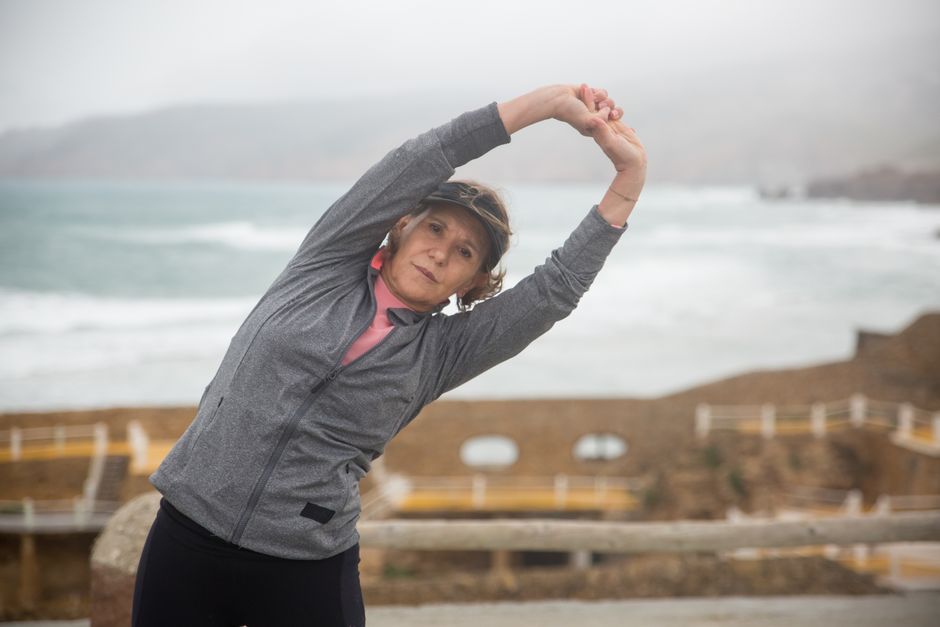
Photo: RDNE Stock project via Pexels
This article is for general informational purposes only and does not constitute medical or fitness advice. Consult your physician or a licensed physical therapist before starting a new exercise program, especially if you have existing health conditions.