 Robert Davis
Most people assume unsteadiness is just something that creeps in with age. You feel a little wobbly on the stairs, grab the handrail more than you used to, maybe catch yourself leaning against the kitchen counter while reaching into a cabinet. And somewhere along the way, someone probably told you to “be careful.” As if being careful is a plan.
It’s not. And that advice, well-meaning as it is, actually makes things worse. When you start moving more cautiously, shortening your stride, shuffling instead of stepping, you’re training your body to be more fearful, not more stable. I’ve watched this happen dozens of times in clients, and I’ve had to gently undo a lot of “be careful” instincts before we could start doing real work.
Here’s what’s actually going on, and more importantly, what you can do about it.
Why Balance Gets Harder (and Why It’s Not Inevitable)
Balance isn’t a single thing. It’s a three-way conversation between your eyes, your inner ear, and the sensory receptors in your feet, ankles, and joints. Clinicians call that last system proprioception. As of 2026, the research on age-related proprioceptive decline is pretty clear: after age 60, the nerve conduction speed in your lower extremities slows measurably, which means the feedback loop from your feet to your brain takes longer. Not dramatically longer, but enough to matter when you step off a curb or hit an uneven patch of sidewalk.
The inner ear piece is real too. The tiny hair cells in your vestibular system thin out over time, and some medications (certain blood pressure drugs, diuretics, and especially antihistamines like diphenhydramine) make this worse. If you started feeling unsteady around the same time you started a new medication, that’s not a coincidence worth dismissing.
What most people don’t realize is that muscle weakness, specifically in the hip stabilizers and ankle complex, is probably the most correctable factor in the mix. A 2023 study published in the Journal of Gerontology found that targeted strength training in adults 65-85 improved postural sway measurements by an average of 31% over 12 weeks. That’s a significant number. And you don’t need a gym to get there.
The Actual Mechanics of Unsteady Walking
When I first started working with older adults, I assumed most of the unsteadiness was coming from the hips. I was partially right, but I kept missing ankles. The first time a physical therapist colleague of mine pointed to a client’s stiff ankle dorsiflexion as the primary culprit, I felt a little embarrassed I hadn’t caught it sooner.
Here’s the thing: when your ankles can’t flex properly, your body compensates by widening your stance, shortening your stride, and leaning slightly forward. That forward lean shifts your center of gravity ahead of your base of support, which is exactly how people fall. And it feels like general unsteadiness, not like an ankle problem, so most people never connect the two.
A simple self-test: Stand barefoot facing a wall, toes about 4 inches from the baseboard. Try to touch your knee to the wall without your heel lifting. If you can’t do it, your ankle mobility is restricted, and that’s contributing to how you walk more than you probably know.
The hip stabilizers matter for a different reason. The gluteus medius, the muscle that keeps your pelvis level when you’re on one foot (which is most of walking), often weakens without any obvious pain signal. You just start to sway slightly side to side, and stairs start feeling precarious.
What Actually Works: A Practical Starting Point
I’ll be direct here: the three interventions with the strongest evidence base are progressive balance training, ankle and hip strengthening, and gait retraining. Physical therapy is the gold standard for putting all three together, and if you’ve never had a formal balance assessment, I’d genuinely encourage it before going the DIY route.
That said, I understand not everyone has easy access to PT, and copays add up fast. So let me give you a real starting point.
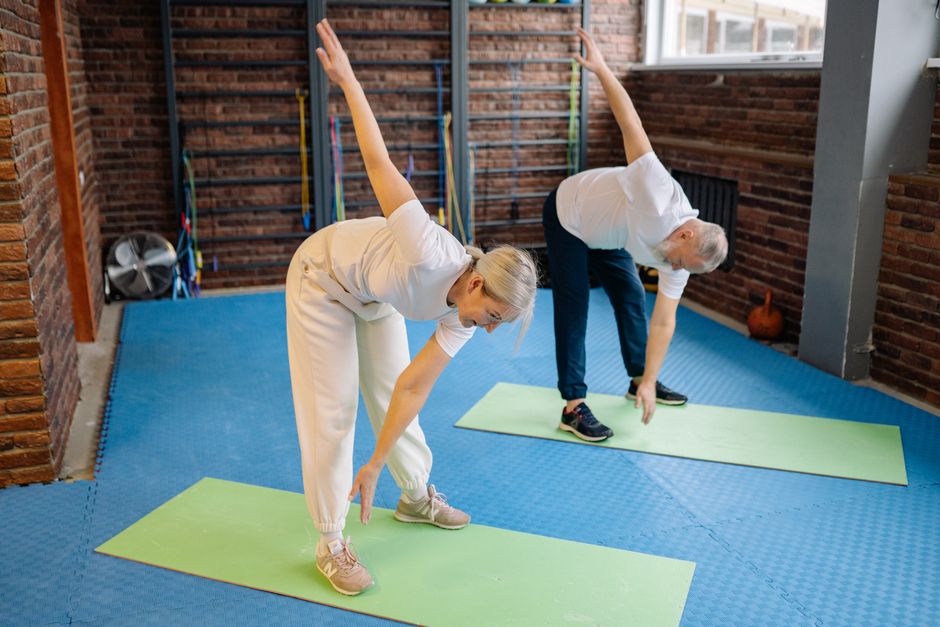
The exercises worth doing daily:
Standing on one foot while holding a chair back. Start with 10 seconds per side, work toward 30. The chair is there for safety, not as something to lean on. There’s a meaningful difference.
Heel-to-toe walking (tandem gait) along a hallway wall. Ten feet down and back, three times. This directly trains the balance systems you use on uneven ground.
Seated ankle circles and dorsiflexion pumps, 20 repetitions, twice a day. Boring? Yes. Effective? More than almost anything else for the ankle stiffness problem.
Side-lying hip abduction with a light resistance band. The Theraband Yellow (about $8 at any pharmacy) is a reasonable starting resistance for most people. Fifteen repetitions, two sets, three days a week.
Calf raises off a step, holding the railing. These train the ankle plantarflexors and improve your push-off, which is what propels you forward instead of shuffling.
I want to be honest that this list won’t fix everything for everyone. If you have peripheral neuropathy, significant vestibular problems, or a neurological condition, these exercises are still worth doing, but you need eyes on your form and a plan tailored to your specific situation.
The Equipment Question
People ask me all the time whether they should get a cane, a walking pole, or some kind of balance aid. My honest answer: it depends, and any PT or physician worth listening to will say the same thing.
A cane used correctly can reduce the load on a weak hip and genuinely improve stability. A cane used as a crutch, leaned on heavily with a shortened stride, can actually accelerate weakness by offloading the muscles you need to strengthen. I’ve seen both outcomes in the same year, in clients with similar starting points.
Nordic walking poles (two poles, used like cross-country ski poles) are interesting because the research on them is more promising than most people expect. A 2022 study in Gait & Posture found that Nordic walking significantly improved walking speed and reduced postural sway in adults over 65, with effect sizes comparable to some supervised exercise programs. They also engage the upper body and core in ways a standard cane doesn’t. Leki makes a solid adjustable set for around $70-$90 that holds up well.
Here’s a rough breakdown of options and what they’re actually suited for:
| Aid | Best For | Approximate Cost | Watch Out For |
|---|---|---|---|
| Single-point cane | Mild balance issues, one-sided weakness | $15-$40 | Can worsen gait if over-relied on |
| Quad cane | Significant instability, post-stroke | $30-$60 | Bulkier, limits natural arm swing |
| Nordic walking poles | Active walkers who want to keep moving | $60-$120/pair | Requires technique learning |
| Rollator walker | Significant frailty, fear of falling | $80-$200 | Can cause forward lean if too far ahead |
| Hiking poles (single) | Outdoor walking on varied terrain | $30-$80 each | Less clinical support, more trail use |
None of these is a permanent sentence. One client I worked with, a retired schoolteacher in her mid-70s named Carol, came to me relying on a quad cane after a fall in her driveway. After five months of targeted strengthening work, she was walking unaided on flat ground and using a single Nordic pole only for outdoor walks on uneven terrain. That’s not unusual if someone puts in consistent effort.
What Your Doctor May Not Have Mentioned
The medication angle is worth a direct conversation with whoever manages your prescriptions. Polypharmacy (taking five or more medications) is associated with significantly higher fall risk, and as of this year, the updated American Geriatrics Society Beers Criteria still flags benzodiazepines, sedating antihistamines, and tricyclic antidepressants as particularly problematic for balance in older adults. If you take any of these and feel unsteady, that’s not just aging. Ask about alternatives.
Vitamin D deficiency also shows up in this conversation more than people expect. A meta-analysis in the British Medical Journal found that supplementing Vitamin D in deficient older adults reduced fall risk by about 22%. The threshold for deficiency is generally under 20 ng/mL on a serum 25(OH)D test. It’s a routine blood test. If it’s been more than a year since you had one, it’s worth asking for.
I don’t have good numbers on the contribution of footwear to falls specifically, but I’ll tell you from watching hundreds of people walk in their home shoes that unsupportive slip-ons and worn-down soles are everywhere in this population, and they matter. A shoe with a firm heel counter, a slight taper, and no more than a half-inch heel-to-toe drop will serve you better than most “comfort” footwear marketed to seniors. The New Balance 928v3 (around $130) gets recommended by podiatrists a lot, and in my experience that reputation is earned.
Tracking Progress (Because It’s Real)
One thing I push hard with every client: measure. Not obsessively, but consistently. The Timed Up and Go test (TUG) is a standard clinical tool you can do at home. Start seated in a chair, stand, walk 10 feet, turn around, walk back, sit. Time it. Under 12 seconds is generally considered normal for adults over 60. Over 20 seconds is a meaningful red flag for fall risk.
Three scenarios I’ve seen play out with consistent work:
Man, 71, had TUG time of 18.4 seconds and described feeling unsteady on stairs. Added daily calf raises, hip abduction with a Theraband, and tandem walking. At 8 weeks, TUG time dropped to 13.1 seconds. Stairs stopped feeling dangerous.
Woman, 68, was having balance issues primarily in dim light (classic vestibular issue). Referred to vestibular physical therapy, added vitamin D supplementation after bloodwork showed deficiency at 14 ng/mL. Six months later, reported 80% reduction in unsteadiness episodes during evening walks.
Man, 74, fell twice in one year after starting a new blood pressure medication. Medication was reviewed by his cardiologist, dosage adjusted. Combined with 10 minutes of daily balance exercises, went 14 months without a fall as of our last contact.
None of these are dramatic stories. They’re just consistent effort paying off, which is how it almost always goes.
Sources
- Journal of Gerontology (2023): Study on targeted strength training and postural sway improvement in adults 65-85
- Gait & Posture (2022): Research on Nordic walking effects on balance and walking speed in adults over 65
- British Medical Journal meta-analysis: Vitamin D supplementation and fall risk reduction in older adults
- American Geriatrics Society Beers Criteria (current 2026 update): Medications associated with increased fall risk in older adults
- Centers for Disease Control and Prevention (CDC) STEADI Program: Evidence-based fall prevention resources and Timed Up and Go test protocol
Photo: Efrem Efre via Pexels
This article is for general informational purposes only and does not constitute medical or fitness advice. Consult your physician or a licensed physical therapist before starting a new exercise program, especially if you have existing health conditions.