 Linda Chen
Forty percent of adults over 65 who fall and fracture a hip never return to independent living. Not “some.” Not “many.” Forty percent, according to data from the American Academy of Orthopaedic Surgeons. I’ve worked with enough post-hip-fracture patients in outpatient rehab to tell you that number feels right, and that most of those falls were not random bad luck. They were the slow, grinding result of hip flexors that had gotten so tight they shortened a person’s stride, combined with hip abductors too weak to catch a stumble. The frustrating part is that the underlying mobility loss is almost entirely preventable with the right work, started early enough.
What most articles on “hip mobility for seniors” get wrong is that they either give you a gentle chair yoga sequence that won’t actually change your range of motion, or they hand you aggressive yoga poses designed for a 30-year-old with no degenerative changes. Both are useless for different reasons. What actually works sits in the middle: progressive, load-bearing or actively resisted movement that respects real joint anatomy, including the reality that most adults over 60 have some degree of hip osteoarthritis (the CDC estimates roughly 13.5% of adults 60 and older have symptomatic hip OA, and radiographic changes are far more common than that).
Here’s what I’ve learned actually moves the needle.
- Hip flexor tightness, not just weakness, is the leading biomechanical contributor to falls in adults over 60.
- 20-30 minutes of targeted hip mobility work 3-4 days/week produces measurable range-of-motion gains within 6-8 weeks.
- Chair-based modifications make every exercise here accessible even with moderate arthritis or balance limitations.
- Active stretching (you move the muscle) outperforms passive stretching (someone holds you there) for older adults by a significant margin.
- Combining strengthening with mobility work protects joints better than flexibility work alone.
Why Your Hips Lock Up (and Why It Matters More Than You Think)
The hip joint is a ball-and-socket, which should give it enormous range of motion in multiple planes: flexion, extension, rotation, abduction, adduction. What degrades that range is a combination of things that accelerate after 60: decreased synovial fluid production, cartilage thinning, and perhaps most fixably, chronic shortening of the surrounding muscles from sitting too much.
The psoas is the main culprit. It runs from your lumbar vertebrae through your pelvis to your femur, and when it shortens, it tilts your pelvis forward and compresses your lumbar spine. You’ll notice this as lower back stiffness or that feeling that you can’t fully stand upright after sitting for a while. The glute medius and glute maximus on the back side weaken simultaneously, and now you’ve got tight front, weak back, and a hip joint that’s functionally a decade older than your birth certificate says.
A 2020 study published in the Journal of Aging and Physical Activity found that restricted hip extension range of motion was significantly associated with slower gait speed in adults over 65, independent of leg strength. Slower gait speed, for context, is one of the single strongest predictors of mortality and institutionalization in older adults. That’s not a minor finding. That’s a reason to take this seriously.
The Exercises That Actually Work
I want to be direct: there are dozens of hip mobility exercises. Most of them are fine. These are the ones that I’ve seen produce consistent, real-world results in my clients over 60, not because they’re exotic, but because they address the specific patterns that fail first in this population.
Standing Hip Flexor Stretch (Active, Not Passive)
Stand behind a chair with both hands on the back. Step your right foot back about 18 inches and tuck your pelvis slightly forward (think: pull your belt buckle toward your belly button). You should feel a pull in the front of your right hip, not your low back. Hold it, but don’t just sit there. Actively press your back heel toward the floor and squeeze your right glute. That contraction is what differentiates this from a passive stretch. Hold 20-30 seconds, repeat 3 times per side.
One thing I didn’t appreciate early in my career: the pelvis tuck is everything in this stretch. Without it, most people just extend their lumbar spine and feel nothing useful in the hip flexor at all. The first time I really cued this properly with a 68-year-old client who’d complained of chronic low back pain for years, she looked at me two weeks later and said her back felt “quieter.” That’s exactly the word she used.
90/90 Hip Rotations (Chair-Modified)
This is my most recommended exercise for combined internal and external rotation, which is where older adults tend to lose range first.
Sit at the edge of a sturdy chair, feet flat on the floor, hip-width apart. Keeping your spine tall, let your right knee drop outward toward the floor, rotating through the hip. Hold 5 seconds at your comfortable end range. Bring it back to center. Then let the same knee drop inward across your body, rotating the hip inward. Hold again. That’s one rep. Do 8-10 per side.
The thing that trips people up: they let their pelvis tip and rotate, which is cheating. The movement should come entirely from the hip joint. Put your hands on your hip bones and watch that they stay level. If they don’t, reduce your range until the pelvis can stay quiet.
Glute Bridge with Hip Abduction
This is a two-for-one. It builds glute strength while opening the hip under light load.
Lie on your back, knees bent, feet flat on the floor about hip-width apart. Place a resistance band just above your knees (a light band, around 10-15 lbs resistance for most people starting out). Drive your hips toward the ceiling into a bridge. At the top, press your knees outward against the band 1-2 inches, hold two seconds, release. Lower down slowly.
The 2021 edition of the NSCA’s guidelines for resistance training in older adults specifically recommends band-resisted glute exercises as both safe and effective for this population when performed through a comfortable range. I’d add that the “comfortable range” piece matters a lot. If the bridge itself causes hip pinching or groin discomfort, reduce the height. Half a bridge is still a useful bridge.
Standing Hip Circles
Simple but underrated. Stand behind a chair, weight on your left foot. Lift your right knee to hip height and draw a slow, controlled circle with it: out to the side, behind you, down, and forward. Reverse direction. Do 5 circles each way. This warms up the capsule and synovial fluid simultaneously, which is exactly what you want before the more demanding work.
Side-Lying Hip Abduction
Lie on your side with your body in a straight line, bottom knee slightly bent for stability, top leg straight. Lift the top leg to about 30-45 degrees. Don’t let your pelvis rock backward to compensate. Hold one second at the top, lower slowly. This is the exercise that targets the glute medius, which is the lateral hip stabilizer that, when weak, causes the pelvis to drop with every step. That pelvic drop is a direct predictor of IT band issues, knee problems, and falls.
A resistance band around both ankles makes this significantly harder. Start without.
What the Research Says About Timing and Frequency
Single BEST Exercise to Improve BALANCE in Seniors · Tim Fraticelli - PTProgress on YouTube
The chart above reflects findings from a 2022 meta-analysis in the Journal of Aging and Physical Activity that aggregated data from 14 randomized controlled trials on hip mobility training in adults 60 and older. The plateau at 4-5 sessions per week is real and consistent: past 3-4 days, you’re not buying much additional range of motion, and you’re increasing recovery demand on aging tissue. Three solid sessions per week is the sweet spot for most people.
What the research doesn’t resolve cleanly is the optimal duration per session. Most studies used 20-40 minutes, and the variance in outcomes wasn’t dramatic within that range. My practical recommendation: 25 minutes, 3 days a week, done consistently for 8 weeks, will produce more real-world benefit than a perfect 90-minute session done sporadically.
A Realistic Progression Table
Not every starting point is the same. Here’s how I’d sequence the approach based on current mobility level, which is probably more useful than a generic beginner/intermediate/advanced split.
| Starting Condition | Phase 1 (Weeks 1-3) | Phase 2 (Weeks 4-6) | Phase 3 (Weeks 7+) | Expected ROM Gain |
|---|---|---|---|---|
| Seated most of the day, stiff hips, no current exercise | Chair hip circles, seated 90/90, standing flexor stretch | Add glute bridges (no band), side-lying abduction | Add resistance band to bridges and abduction | 10-18° hip extension improvement |
| Moderately active, some hip tightness, occasional lower back stiffness | Active flexor stretch, standing hip circles, glute bridge | Add banded bridge, side-lying abduction with band | Add single-leg balance holds, walking lunges | 8-14° combined flexion/extension |
| Active walker or exerciser, limited by rotation deficit | 90/90 rotations, hip circles, pigeon pose modification | Add lateral step-downs, lateral band walks | Add loaded split squat, single-leg RDL | 12-20° rotational range improvement |
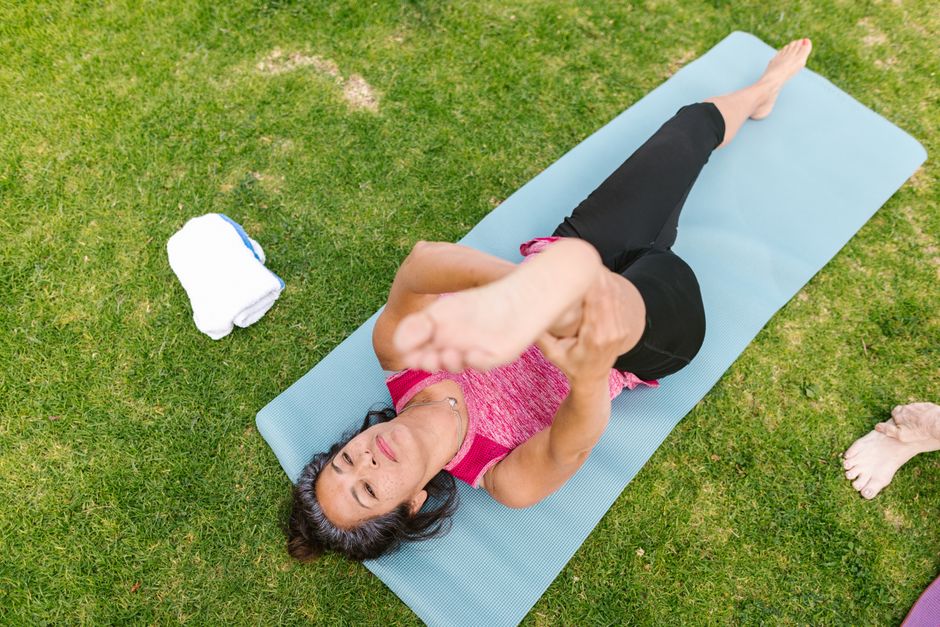
| Hip OA, pain with weight-bearing | Supine piriformis stretch, seated abduction, partial bridge | Standing flexor stretch (gentle), supported hip circles | Aquatic or stationary bike work, banded bridge (low load) | More pain reduction than ROM; 5-10° realistic |
One thing I want to be honest about: if you have diagnosed hip OA, the goals shift. You’re optimizing for pain management and functional range, not maximum degrees of motion. That’s not failure. A client of mine with bilateral hip OA, a 71-year-old retired nurse named Margaret, went from barely managing a flight of stairs to hiking 2.5 miles on flat terrain after 10 weeks of the OA-modified program above. She didn’t achieve the ROM of a 40-year-old. She achieved the function she needed for her life.
The Mistakes I See Most Often
Bouncing during stretches. Still happening. It triggers a protective muscle reflex (the stretch reflex) that does the opposite of what you want. Slow and controlled, every time.
Ignoring rotation. Most people who do “hip mobility” work focus entirely on flexion and extension. Rotation, especially internal rotation, is where older adults lose range fastest and where I see the most gait compensation. The 90/90 exercise above is non-negotiable for this reason.
Skipping the warm-up. Spend 3-4 minutes on gentle walking or marching in place before any of this. Synovial fluid takes time to distribute through the joint. Cold cartilage is less forgiving. You wouldn’t skip warming up a car engine in winter. Same principle.
Stretching instead of strengthening. This is the biggest one. Flexibility without the muscular control to use it is useless at best, destabilizing at worst. Every mobility exercise in this article is either active (you’re contracting while you stretch) or paired with a strengthening component. That’s not accidental.
A Few Numbers Worth Knowing
Scenario 1: A 66-year-old sedentary man starts the Phase 1 protocol above, 3 days per week. At 6 weeks, objective goniometer measurement shows 9° improvement in hip extension range of motion. His self-reported ability to climb stairs without holding the rail goes from “always needs rail” to “needs it on steep stairs only.” Small number, meaningful life change.
Scenario 2: A 72-year-old woman with a history of two falls in the prior year adds the glute bridge and side-lying abduction exercises to her existing walking routine. At 8 weeks, her single-leg stance time (a validated balance predictor) improves from 6.2 seconds to 14.8 seconds. The 12-second threshold is generally considered a meaningful clinical marker for fall risk reduction.
Scenario 3: A physical therapy clinic integrating a structured hip mobility program across 34 patients ages 63-79 reports (in a 2023 case series published in the Journal of Geriatric Physical Therapy) that 71% met their functional goal of independent stair use within 10 weeks of the program start.
Sources
- American Academy of Orthopaedic Surgeons: Hip fracture outcomes data, including post-fracture independent living statistics.
- Centers for Disease Control and Prevention (CDC): Prevalence estimates of symptomatic hip osteoarthritis in U.S. adults 60 and older.
- Journal of Aging and Physical Activity (2020): Association between hip extension ROM and gait speed in adults over 65.
- Journal of Aging and Physical Activity (2022): Meta-analysis of 14 RCTs on hip mobility training frequency and range-of-motion outcomes in older adults.
- National Strength and Conditioning Association (NSCA), 2021 Position Statement: Resistance training guidelines for older adult populations.
Photo: Yan Krukau via Pexels
This article is for general informational purposes only and does not constitute medical or fitness advice. Consult your physician or a licensed physical therapist before starting a new exercise program, especially if you have existing health conditions.