 Robert Davis
Most people assume the hardest part of getting stronger after 60 is the work itself. I’d argue it’s actually the misinformation you have to wade through first.
Pick up almost any fitness magazine aimed at seniors and you’ll find the same tired advice: light weights, high reps, take it easy. And I’ll be honest, I used to hand out some of that advice myself early in my career. What changed my mind was watching a 68-year-old client named Margaret go from struggling to carry her groceries to deadlifting 45 pounds in four months, because we stopped “taking it easy” and started actually training her. The research backs this up. A landmark study published in the Journal of the American Medical Association found that progressive resistance training in adults over 65 produced meaningful gains in both strength and functional capacity, and that those gains were comparable, percentage-wise, to what younger adults achieve. The “fragile elder” model isn’t just limiting. It’s often flatly wrong.
What follows is the real story on dumbbell training at home for people over 60. Not the sanitized version.
Why Dumbbells, and Why at Home?
| Equipment | Cost Per Pair | Weight Range | Setup Friction |
|---|---|---|---|
| Adjustable Dumbbells (Bowflex SelectTech 552) | ~$400 | 5-52.5 lbs | Minimal |
| Fixed-Weight Dumbbells (Light Set) | $30-$60 | 5-8 lbs | Minimal |
| Fixed-Weight Dumbbells (Medium Set) | $30-$60 | 10-15 lbs | Minimal |
| Gym Membership | $50-$80/month | Varies | High |
Barbells are great. Machines have their place. But dumbbells are genuinely the best starting point for most older adults working independently, and here’s the specific reason: they require each limb to work on its own. That sounds minor until you realize that most falls and functional limitations in older adults stem from side-to-side imbalances that a barbell quietly lets you compensate around. When your right side is weaker than your left, a barbell lets your left carry more of the load. Dumbbells don’t let you cheat that way.
Home training removes the friction that kills consistency. The gym requires driving, parking, changing, waiting for equipment, and managing the psychological weight of being watched. None of that sounds like much until you’re 72 and your knee hurts on a cold morning. A set of adjustable dumbbells in your living room means the barrier to showing up is essentially zero.
As of July 2026, adjustable dumbbell sets remain the most practical investment for home training. The Bowflex SelectTech 552s run around $400 for a pair and replace 15 separate dumbbells from 5 to 52.5 pounds. That’s expensive up front. But compare it to a gym membership at $50 to $80 a month that you’ll use inconsistently, and the math shifts quickly. If fixed-weight dumbbells feel more intuitive, buying a few pairs (a light set around 5-8 lbs, a medium around 10-15 lbs) runs $30 to $60 per pair at most sporting goods stores. Perfectly adequate.
The Exercises That Actually Matter
I want to be selective here, because too many “senior dumbbell” articles list 20 exercises and leave you overwhelmed. Six movements, done consistently, will build more strength than rotating through a 20-exercise circuit once a month.
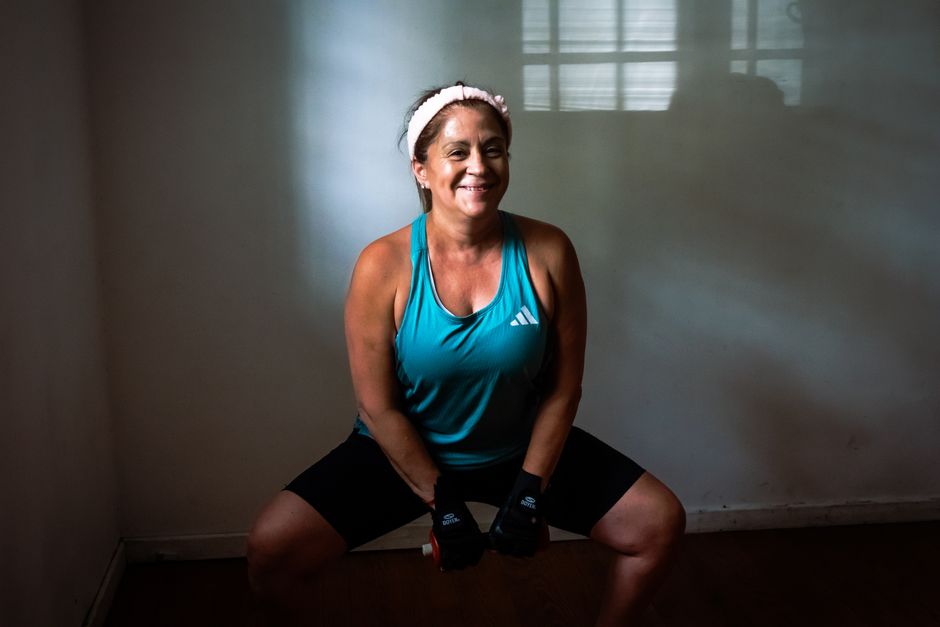
Goblet Squat. Hold one dumbbell vertically at chest height with both hands. Feet shoulder-width apart, toes turned out slightly. Lower until your thighs are roughly parallel to the floor (or as low as your knees comfortably allow), keeping your chest up. Push through your heels to stand. This is the single most functional lower-body exercise I’ve found for older adults. It trains the exact movement pattern you use getting up from a chair, a toilet, or the floor. Start with 8 to 10 lbs and take it seriously.
Romanian Deadlift. Hold a dumbbell in each hand, standing tall. Hinge at the hips (not the waist, the hips), sending them back as the dumbbells lower along your thighs, until you feel a stretch in your hamstrings. Stand back up by driving your hips forward. This builds the posterior chain, which is your low back, glutes, and hamstrings, the muscles most responsible for back pain prevention and hip stability. Most beginners feel this in their low back instead of their hamstrings, which tells me they’re rounding their spine. If that’s you, lighten the weight and practice the hinge motion holding a broomstick first.
Seated Dumbbell Press. Sit tall in a sturdy chair, a dumbbell in each hand at shoulder height. Press both overhead until arms are extended (don’t lock out hard), then lower with control. Shoulder strength is vastly underrated in fall prevention because your arms are often the last thing between you and the floor when you stumble. I had a client who avoided overhead pressing for two years because of an old rotator cuff issue, and when we finally reintroduced it with proper technique and 5-pound dumbbells, she said it was the first time in years she could reach the top shelf without discomfort. Progress was slow. Four months to get to 12 lbs. Absolutely worth it.
Dumbbell Row. Place one knee and one hand on a bench or sturdy chair for support. Hold a dumbbell in your free hand and pull it toward your hip, elbow skimming close to your body. Lower with control. This builds upper back strength, which directly counteracts the forward-rounding posture (kyphosis) that becomes increasingly common after 60. Pulling movements are chronically underrepresented in most people’s home routines.
Farmer’s Carry. Pick up a dumbbell in each hand and walk. That’s it. Walk across your living room, turn around, walk back. This exercise has almost no learning curve, and what surprised me when I started programming it more consistently was the impact it had on grip strength, core stability, and gait quality all at once. Grip strength, by the way, is one of the strongest predictors of all-cause mortality in older adults, per research published in The Lancet. It sounds alarmist, but the data is genuinely consistent on this point.
Lateral Raise (Light). Standing or seated, hold a light dumbbell in each hand at your sides. Raise both arms out to the side until shoulder height, then lower slowly. The “slowly” part is where most people rush and where the benefit lives. Control the descent over 3 to 4 seconds. This exercise specifically targets the deltoids and the small stabilizing muscles of the shoulder complex that keep your shoulder joint healthy long-term. Don’t go heavy. 5 to 8 pounds is appropriate for most people starting out, even if you feel strong.
The Progressive Overload Problem (And Why Most People Miss It)
5 Exercises for Seniors to do EVERY DAY · Vive Health on YouTube
Here’s what separates training from exercise. Exercise is just movement. Training means you’re applying a stimulus that’s slightly harder over time, so your body has a reason to adapt.
I’ve watched well-meaning people do the same 10-pound curls for two years and wonder why nothing changes. The body is efficient. Once it adapts to a load, it stops changing.
Progressive overload for older adults doesn’t have to mean adding weight every single week. That’s actually too aggressive for most people over 60. Better approaches: add one rep per session, slow the lowering phase by a second, reduce rest time between sets, or simply improve your form and range of motion before adding any weight at all. All of these count as progression. You don’t need heavier dumbbells every month to keep getting stronger.
A practical example from my own work: a 71-year-old named Carol started with goblet squats using 8 pounds and could only manage 6 reps before her form broke down. Over 12 weeks, without ever increasing the weight, she improved to 3 sets of 12 clean reps, then we added weight. → By week 16, she was using 20 pounds and her chair-rise speed had improved enough that her daughter noticed unprompted. The weight increase eventually came, but the foundational progression was in quality and volume.
Another example: a reader named Frank emailed me after trying to follow a generic “senior strength” YouTube program that had him doing 3 sets of 20 with a 5-pound dumbbell. He felt like he was going through the motions. We shifted him to 3 sets of 8 with a 15-pound dumbbell on goblet squats, kept careful track of reps, and added one rep per session. → After 10 weeks, Frank reported he’d gone from 8 to 15 reps at the same weight, then stepped up to 20 lbs. He also mentioned his lower back pain, which he’d had for years, had “mostly disappeared.” That wasn’t a coincidence. Stronger posterior chain.
What You Need to Know About Safety (Without the Scare Tactics)
I’ll be honest: safety conversations in senior fitness tend to veer into condescension. So let me just give you the actual non-negotiables.
Control matters more than load. A weight you can lift but can’t lower slowly is too heavy. The lowering phase (eccentric) is where a lot of the strength-building stimulus comes from, and where a lot of injuries happen when people rush it.
Shoes matter more than most people realize. Thick, cushioned running shoes are actually problematic for strength training because they reduce the proprioceptive feedback you get from the floor. A flat, firm-soled shoe (or bare feet if your floors are safe) gives you a more stable base for squatting and pressing. This surprised me the first time a physical therapist colleague pointed it out, and I’ve seen it make a real difference since.
The research on rest is mixed in terms of exact timing, but a general guideline of 60 to 90 seconds between sets works well for most older adults. Some people do better with 2 minutes, especially when managing blood pressure. Don’t rush it.
If you have osteoporosis, spinal stenosis, or recent joint replacement surgery, please don’t just follow a generic program. Those conditions don’t rule out dumbbell training, not at all, but they do require some specific modifications that really should come from someone who knows your imaging and your history. A single session with a certified personal trainer or physical therapist can save you months of working around a preventable injury.
Sources
- American College of Sports Medicine (ACSM): Position Stand on Exercise and Physical Activity for Older Adults, recommending progressive resistance training 2 or more days per week for adults 65 and older.
- Fiatarone et al., JAMA (1990): Landmark study demonstrating significant strength gains in frail nursing home residents aged 72-98 through high-intensity resistance training.
- Leong et al., The Lancet (2015): Prospective cohort study linking grip strength to cardiovascular disease, all-cause mortality, and functional outcomes across 17 countries.
- National Institute on Aging (NIA): Go4Life program guidelines on strength, balance, and flexibility training for older adults, updated guidance current as of 2026.
- Reid et al., Archives of Internal Medicine (2008): Randomized trial showing progressive resistance training reduced fall risk and improved functional mobility in community-dwelling older adults.
Photo: Kampus Production via Pexels
This article is for general informational purposes only and does not constitute medical or fitness advice. Consult your physician or a licensed physical therapist before starting a new exercise program, especially if you have existing health conditions.