 James Cooper
Maybe you sat down in a chair recently and noticed it took more effort than it used to. Or you caught yourself gripping the railing on the stairs in a way you never thought twice about before. These moments can feel alarming, but here’s something I want you to hear right away: they are incredibly common, and they are not a sign that decline is inevitable. Muscle loss, known clinically as sarcopenia, begins in our 40s and accelerates after 60, but research consistently shows that strength training can reverse meaningful amounts of that loss at virtually any age. The remarkable part is that you don’t need a gym membership, a rack of dumbbells, or any equipment at all to start building real strength. Your own bodyweight, used correctly, is a genuinely powerful tool.
Why Bodyweight Training Works Especially Well After 60
You might be wondering whether bodyweight exercise is actually challenging enough to build muscle, or whether it’s just “light movement” dressed up in fitness language. That’s fair.
Muscle grows when it’s placed under enough tension to trigger repair and adaptation. That tension doesn’t have to come from external weight. When you lower yourself slowly into a chair and pause halfway down, your quads and glutes are working hard. When you push up from a countertop at a steep angle, your chest, shoulders, and triceps are all engaged. The key variables are range of motion, tempo, and progressive difficulty, not the source of the resistance.
For older adults specifically, bodyweight training has real advantages over dumbbells or machines. There’s no equipment to purchase, store, or drop on your foot. The movements mirror daily life, so the strength you build transfers directly to getting up from a sofa, reaching overhead, or stepping up a curb. And because you’re moving your own body through space, your nervous system and balance systems get trained alongside your muscles. A leg press machine can’t do that.
I’ve worked with clients in their 70s and 80s who assumed their window for building strength had closed. Within eight to twelve weeks of consistent bodyweight training, most of them were moving with noticeably more confidence. Not because we did anything extreme, but because we were consistent and progressive.
The Foundational Movements: What to Focus On
There are hundreds of exercises out there. Sorting through them can feel overwhelming. Focus on six fundamental movement patterns, and you’ll cover almost every muscle group and functional demand your body faces daily.
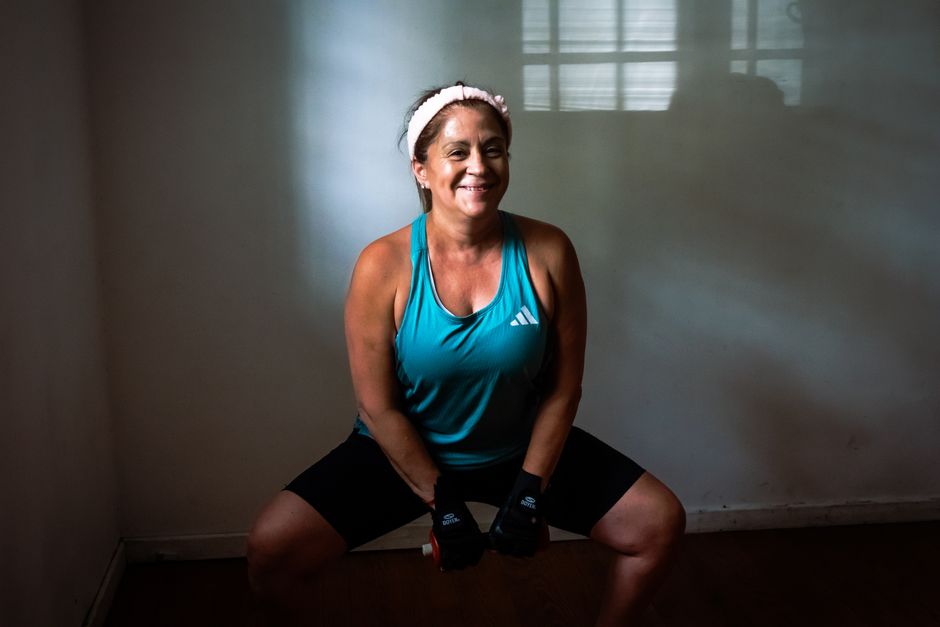
Squat pattern: Sit-to-stand from a chair is the safest starting point. It builds the quads, glutes, and hamstrings while training exactly the movement that separates independent living from needing help getting up.
Hip hinge: Bending forward from the hips with a neutral spine, rather than rounding through the low back. A simple standing hip hinge while holding onto a counter teaches proper spinal mechanics and strengthens the posterior chain, the glutes, hamstrings, and lower back.
Pushing: Countertop push-ups or incline push-ups against a wall train the chest, shoulders, and triceps without the shoulder strain that floor push-ups can cause for beginners.
Pulling: This is harder without equipment, but a doorframe row or an underhand grip on a sturdy table edge can effectively work the biceps, upper back, and rear deltoids.
Core stability: Not crunches. True core stability for older adults means resisting unwanted movement of the spine, achieved through exercises like standing dead bugs (arms and legs move while the torso stays still) or a modified bird dog from a hands-and-knees position.
Balance and single-leg work: Single-leg stands, heel-to-toe walks along a line, and gentle lateral stepping train the stabilizer muscles of the hip and ankle that prevent falls.
You don’t need to do all six in every session. Three sessions per week is a reasonable starting point, alternating between lower-body and upper-body focus, with balance work woven in throughout.
A Step-by-Step Starter Routine
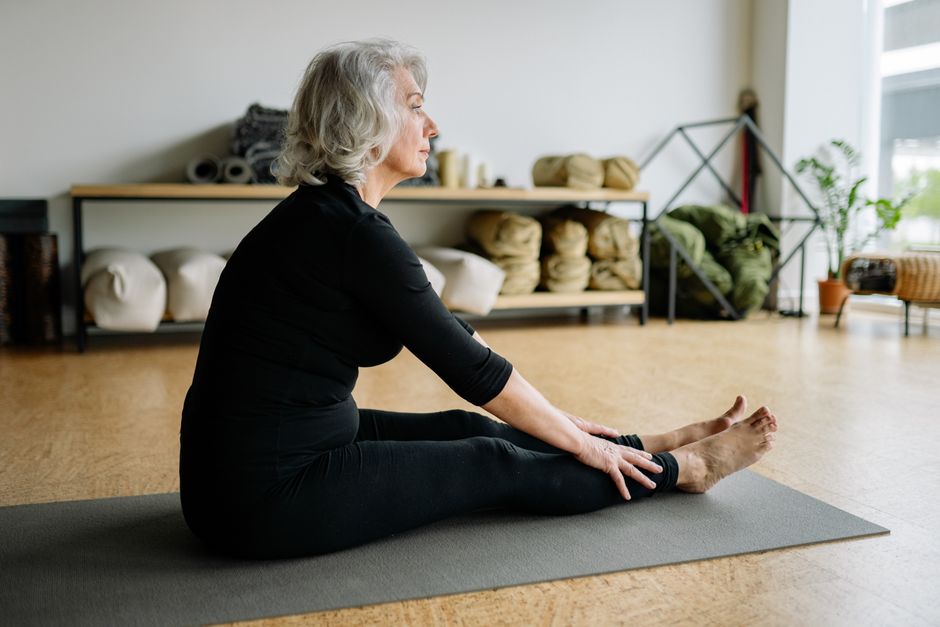
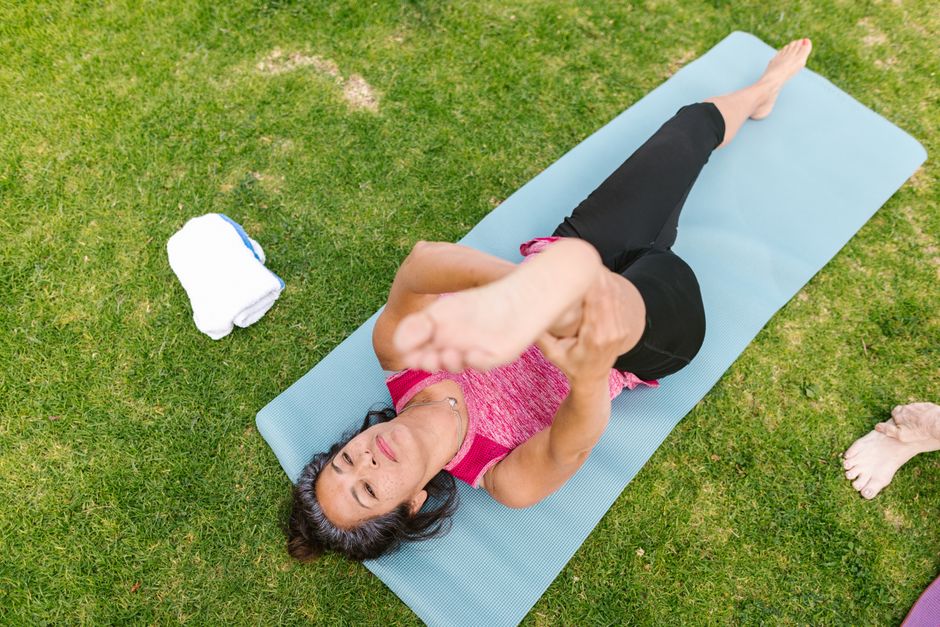
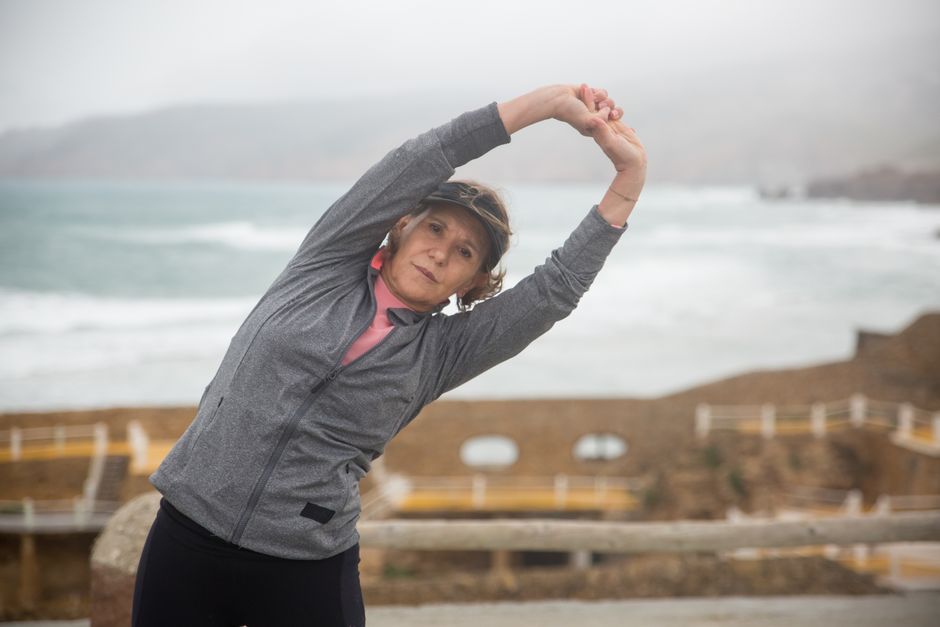
10 Stretching Exercises for 60 Year Olds: Mobility and Strength Training · Yes2Next on YouTube
This routine is designed for someone beginning from a relatively sedentary baseline. If you have joint replacements, osteoporosis, or a history of falls, check with your physician or physical therapist before starting, as modifications will apply.
Warm-Up (5 minutes)
- Seated ankle circles: 10 in each direction
- Seated marching in place: 30 seconds
- Standing, holding a countertop: slow heel raises, 10 repetitions
Main Workout (20 to 25 minutes)
Chair Sit-to-Stand: Stand in front of a sturdy chair with feet hip-width apart. Lower yourself slowly, counting 3 seconds down, until you lightly touch the seat, then stand back up. Start with 8 repetitions, rest 60 seconds, repeat for 2 sets. As this becomes easier, try hovering just above the seat instead of fully sitting.
Countertop Push-Up: Place hands on a counter or sturdy table, slightly wider than shoulder-width. Walk your feet back until your body forms a diagonal line. Lower your chest toward the counter slowly, 3 counts down, 1 count up. Start with 8 repetitions, 2 sets. Progress over weeks by using a lower surface.
Standing Hip Hinge: Hold a countertop lightly for balance. Feet hip-width apart, soft bend in the knees. Push your hips backward while keeping your back flat and letting your torso tip forward. Feel a gentle stretch in the back of your thighs, then drive your hips forward to stand tall. 10 repetitions, 2 sets.
Bird Dog: From a hands-and-knees position on a mat, extend your right arm forward and your left leg back simultaneously. Hold 3 seconds. Return and switch sides. Keep your hips level and avoid letting them rotate. 6 repetitions per side, 2 sets.
Single-Leg Stand: Stand near a wall or countertop for safety. Lift one foot an inch off the floor and hold for 10 seconds. Switch sides. Work toward 30-second holds without touching the support.
Cool-Down (5 minutes)
- Seated calf stretch against a wall
- Standing quad stretch holding a wall
- Gentle neck rolls
Track your repetitions and how the sets felt each session. When a given number of reps feels manageable for two consecutive sessions, increase by 2 reps or add a third set before making the movement harder.
Progressing Without a Gym: How to Keep Getting Stronger
One of the most common mistakes I see is people finding a routine that feels comfortable and staying there. Comfort is the enemy of progress in strength training. Your body adapts to a given stimulus in roughly four to six weeks, after which the same exercise produces diminishing returns.
The good news: bodyweight exercise offers many ways to increase difficulty without adding weight.
Slow the tempo down. A squat done in 5 seconds on the way down is significantly harder than one done in 1 second. This is called time under tension, and it’s one of the most underused tools available.
Reduce your base of support. Going from two feet to one foot, or from a wide stance to a narrow one, dramatically increases balance and muscular demands.
Change the leverage. Push-ups progress from wall, to countertop, to table, to chair, and eventually to the floor. Each step increases how much of your bodyweight you’re lifting.
Add pauses. Pausing at the hardest point of a movement, halfway down in a squat, for instance, eliminates momentum and forces your muscles to work harder.
Increase range of motion. A chair squat where you hover two inches above the seat is harder than one where you fully sit. Deeper range of motion recruits more muscle fibers.
Revisit your routine every three to four weeks and introduce at least one of these progressions.
The Role of Consistency and Rest (Both Matter More Than You Think)
Sources
- Maksim Goncharenok
- consistently shows that strength training can reverse meaningful amounts of that
Strength is built during recovery, not during exercise. This is true at every age, but it becomes more significant after 60 because recovery processes slow down. Muscles need adequate protein to rebuild. The American College of Sports Medicine recommends that older adults aim for 1.0 to 1.2 grams of protein per kilogram of body weight daily, and spreading protein intake across meals rather than concentrating it at dinner produces better muscle synthesis.
Sleep isn’t a luxury for someone doing strength training. Growth hormone, which plays a central role in muscle repair, is released primarily during deep sleep. Seven to nine hours a night isn’t just general health advice; for someone working on rebuilding strength, it’s part of the program.
Rest days matter too. Doing the same exercises every single day doesn’t accelerate progress; it blocks it. Two to three strength sessions per week with active rest days (walking, gentle stretching, water exercise) is the structure that produces consistent results over months and years.
Starting a bodyweight training practice after 60 isn’t about recapturing youth or competing with anyone. It’s about making the next decade feel more capable, more confident, and more your own. The body you have right now is already capable of more than you might believe. Give it consistent, progressive challenge. Get enough protein and sleep to recover. Be patient and let adaptation happen. That’s really all the formula requires. If you’re not sure where to begin, a single session with a certified trainer or physical therapist who works with older adults can give you a personalized starting point that’s worth far more than any generic program.
Photo: Maksim Goncharenok via Pexels
This article is for general informational purposes only and does not constitute medical or fitness advice. Consult your physician or a licensed physical therapist before starting a new exercise program, especially if you have existing health conditions.