 Linda Chen
Most people I work with who are 70 or older come in carrying one of two things: fear or frustration. Sometimes both. Fear that lifting anything heavier than a grocery bag will hurt them. Frustration that everything they’ve tried either felt pointless or left them sore in the wrong ways. You might be wondering right now whether strength training is even safe for you at this stage, or whether it’s already too late to make real gains. I want to address that second thought first, because it’s the one that does the most damage.
It’s not too late. Not even close.
Research published in the Journal of Strength and Conditioning Research has consistently shown that adults in their 70s and 80s can increase muscle strength by 25 to 30 percent over 12 weeks of progressive resistance training. I’ve seen that play out in real life more times than I can count. One of my clients, Dorothy, was 74 when she started with me after a minor fall in her kitchen. She hadn’t done structured exercise in decades. After six months of twice-weekly sessions, she could get up off the floor unassisted, carry her own groceries, and her bone density scan showed measurable improvement. That’s not extraordinary. That’s what this kind of training actually does.
Why Most “Senior Exercise” Programs Sell You Short
Here’s where I’m going to say something that might surprise you: most content aimed at older adults dramatically underestimates what you’re capable of. Pink dumbbells, seated arm circles, five-pound lateral raises. I don’t want to be dismissive, because movement is always better than no movement. But if we’re talking about building the strength that protects you from falls, keeps you out of assisted living, and lets you carry on the life you actually want to live, that programming isn’t going to get you there.
The research backs me up on this. A 2019 meta-analysis in Sports Medicine reviewed 49 studies on resistance training in adults over 60 and found that higher-intensity programs (meaning loads at 70 to 85 percent of a one-rep max) produced significantly greater gains in functional strength than low-intensity programs. The older adults in those studies didn’t get hurt at higher rates, either. Proper form and progressive overload matter far more than keeping the weight light “just to be safe.”
That said, I’m not suggesting you walk into a gym tomorrow and max out a leg press. There’s a smart way to build up to challenging loads, and that’s what the rest of this article is about.
The Exercises That Actually Matter
I’ll be honest: when I first started working with older adults, I thought I needed a completely different exercise library than what I used with younger clients. I was wrong. The movements that build real-world strength in a 75-year-old are largely the same ones that do it for a 40-year-old. The difference is in how you get there.
Goblet Squat
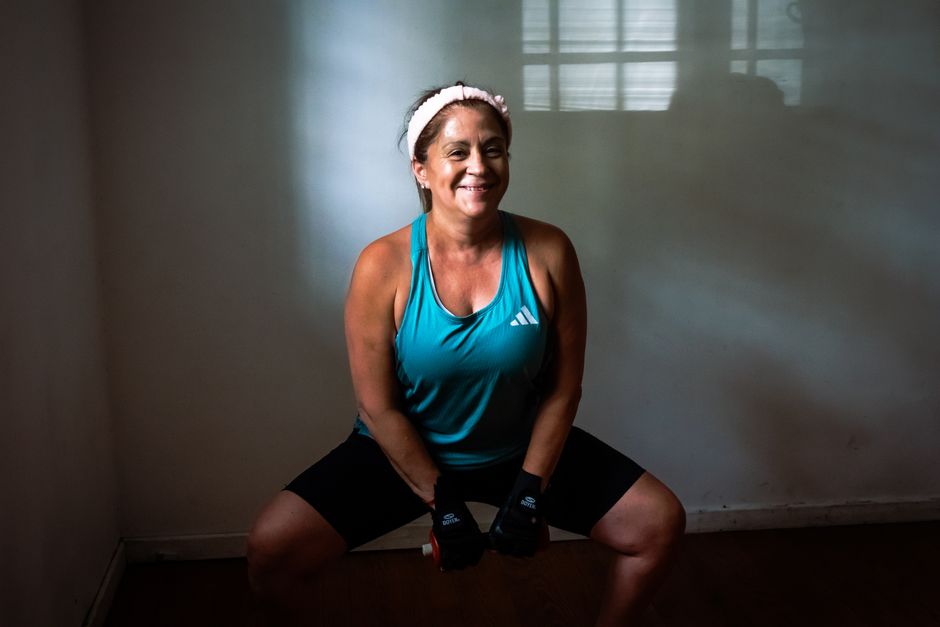
If you can only do one lower-body exercise, make it this one. Hold a single dumbbell or kettlebell at your chest, feet shoulder-width apart, and squat down until your thighs are roughly parallel to the floor (or as low as your knees and hips comfortably allow). The weight at your chest acts as a counterbalance, which actually makes it easier to maintain an upright torso than a bodyweight squat. For someone just starting out, a 10 to 15-pound dumbbell is a reasonable starting point. The goal over time is to work up to a weight that makes the last two or three reps of a set genuinely challenging.
This exercise builds quad strength, glute strength, and hip mobility simultaneously. All three are directly correlated with fall prevention.
Seated Row (or Resistance Band Row)
Most people over 70 that I work with have significant weakness in the muscles that pull their shoulders back, which contributes to that rounded-forward posture you see and which puts constant strain on the lower back and neck. A seated cable row at the gym, or a resistance band row at home anchored to a door, addresses this directly. Pull the handles or band toward your lower ribcage, keep your shoulders down, and squeeze your shoulder blades together at the end of the movement.
Bands are inexpensive and genuinely useful here. A set of TheraBand resistance bands runs about $25 to $35 on Amazon and gives you enough variety to progress over months.
Step-Up
Underused, underrated. Find a stable step, a sturdy box, or even the bottom stair in your house. Step one foot up, drive through that heel to stand fully on the step, then lower back down slowly. That slow lowering phase (called the eccentric) is where a lot of the strength benefit happens, and it’s also what trains your legs to control your body when you’re going down stairs, curbs, or uneven terrain.
Start with just your bodyweight. Add dumbbells when stepping up with bodyweight feels genuinely easy for three sets of 10.
Hip Hinge / Romanian Deadlift
This is the one I see done wrong most often, even in people who’ve been exercising for years. The hip hinge is the movement pattern where you push your hips back (not down) while keeping your spine neutral, then drive them forward to stand. In daily life, this is how you should be picking anything up off the floor. In the gym, it becomes a Romanian deadlift with dumbbells or a barbell.
The hamstrings and glutes are your body’s primary hip stabilizers, and in most adults they’re dramatically underdeveloped relative to the quads. Correcting that imbalance reduces back pain, improves balance, and protects your knees.
Push-Up (or Wall Push-Up)
Your starting point here depends on your current upper-body strength. If a full floor push-up isn’t accessible yet, start with hands on a wall or an elevated surface like a kitchen counter. As you get stronger, lower the surface until you’re on the floor. Pushing movements build chest, shoulder, and tricep strength and translate directly to things like pushing yourself up from a chair or out of a pool.
Farmer’s Carry
Pick up two reasonably heavy dumbbells and walk. That’s it. Walk 30 to 50 feet, set them down, rest, repeat. The farmer’s carry trains grip strength (which is a legitimate biomarker of overall health and longevity, according to several large cohort studies), core stability, and shoulder positioning all at once. It’s also one of the safest exercises in existence because the movement pattern is exactly what humans evolved to do.
How to Structure This Into an Actual Program
5 Exercises for Seniors to do EVERY DAY · Vive Health on YouTube
You don’t need to be in the gym five days a week. Two to three days of strength training per week, with at least one full rest day between sessions, is well-supported by the research and completely realistic for most people.
Here’s a comparison of where most 70-plus beginners realistically start versus where a solid 12-week program can take them:
| Exercise | Typical Starting Point | Realistic 12-Week Goal | Primary Benefit |
|---|---|---|---|
| Goblet Squat | 10 lbs, 2x8 | 25 lbs, 3x10 | Leg strength, fall prevention |
| Seated Row (band) | Light band, 2x10 | Medium-heavy band, 3x12 | Posture, upper back |
| Step-Up | Bodyweight, 2x8 per leg | 10–15 lbs dumbbells, 3x10 | Stair safety, unilateral leg strength |
| Romanian Deadlift | 10–15 lbs, 2x8 | 30–40 lbs, 3x10 | Hamstrings, back health |
| Push-Up (wall or floor) | Wall, 2x8 | Countertop or floor, 3x10 | Upper body pushing strength |
| Farmer’s Carry | 10 lbs each hand, 30 ft | 20–25 lbs each, 50 ft | Grip, core, whole-body stability |
These numbers are ranges, not mandates. If you have arthritis, osteoporosis, a replaced hip or knee, or any recent injury, your trajectory will look different and you should be working with a physical therapist, at least initially, to dial in what’s appropriate. I don’t say that as a legal disclaimer. I say it because I’ve watched well-meaning people push through the wrong kind of discomfort and set themselves back months.
What “Progressive Overload” Actually Means When You’re 70
You might have heard this term and assumed it was for 25-year-old gym enthusiasts. Progressive overload just means making your training slightly harder over time so your body keeps adapting. For most of the people I work with, this happens more slowly than it would at 35, and that’s completely fine. Recovery takes longer. That’s not a limitation to fight against. It’s a variable to plan around.
Here’s what I tell people: if you can complete all your sets and reps with good form and the last few reps don’t feel hard, it’s time to add a small amount of weight or an extra set. If you’re still sore three or four days after a session, you went too hard and need to pull back. Muscle soreness the day after or two days after is normal. Soreness or joint pain that lingers past 72 hours is a signal.
One of my clients, Robert, 71, was frustrated three weeks into his program because he felt like he wasn’t making progress fast enough. He’d added weight twice in three weeks and felt like that was slow. I pulled up his intake form from day one and showed him his starting numbers. He’d gone from a 15-pound goblet squat to a 30-pound goblet squat in 21 days. He laughed. “I forgot where I started,” he said. Write your numbers down. It matters more than you think.
The Balance Component You Shouldn’t Skip
Strength and balance are related but not identical. You can be strong and still fall if your balance systems aren’t being trained. Single-leg work (like the step-up, done slowly) helps. So does standing on one foot while you brush your teeth, or walking heel-to-toe along a line on the floor. These are not a substitute for strength training, but they work together with it.
As of July 2026, the National Institute on Aging recommends that adults over 65 include both muscle-strengthening activities and balance training at least two days per week. Their Go4Life program is a solid free resource if you want supplemental guidance.
Sources
- Journal of Strength and Conditioning Research (multiple issues, 2018-2024): Research on resistance training adaptations in adults 65 and older
- Straight, C.R. et al. (2019), Sports Medicine: Meta-analysis of 49 RCTs examining intensity thresholds in senior resistance training programs
- National Institute on Aging, Go4Life Program: Official U.S. government guidelines and exercise resources for older adults, current as of 2026
- Leong, D.P. et al., The Lancet (2015): Landmark cohort study across 17 countries linking grip strength to cardiovascular mortality and all-cause mortality
- American College of Sports Medicine Position Stand on Exercise and Physical Activity for Older Adults: Evidence-based recommendations updated periodically; most recent major revision 2023
Photo: Kampus Production via Pexels
This article is for general informational purposes only and does not constitute medical or fitness advice. Consult your physician or a licensed physical therapist before starting a new exercise program, especially if you have existing health conditions.