 Robert Davis
Most people with bad knees are told to rest. Stop walking so much. Skip the stairs. Take it easy. I spent years watching that advice backfire, and I’ll be honest: it frustrated me every time. Because the research, and two decades of working with older adults, points in exactly the opposite direction. The right kind of movement is frequently one of the best things you can do for a painful knee. The wrong kind of rest is often what makes it worse.
Here’s what surprised me most when I went deep on this topic: a 2019 systematic review published in the British Journal of Sports Medicine found that exercise therapy reduced knee osteoarthritis pain by roughly 40% on average. That’s comparable to what many people get from over-the-counter pain medication, without the side effects. The catch is that not all exercise is equal, and for anyone over 60 with arthritic, injured, or surgically repaired knees, choosing the wrong approach can genuinely cause harm.
So let’s get into what actually works.
This comparison helps you match exercises to your specific knee condition, fitness level, and practical constraints.
| Exercise | Best For | Caution If | Weekly Target | Equipment Needed |
|---|---|---|---|---|
| Pool Walking / Water Aerobics | Severe OA, post-surgical (6+ weeks), obesity (BMI 30+) | Open wounds, ear infections, chlorine sensitivity | 3-4 sessions, 30-45 min each | Pool access (chest-depth water reduces joint load by ~50%) |
| Stationary Cycling | Mild-to-moderate OA, ACL recovery, general deconditioning | Significant patellofemoral pain (adjust seat height first) | 4-5 sessions, 20-30 min each | Recumbent or upright bike; seat high enough for slight knee bend at bottom |
| Elliptical Trainer | Those transitioning from cycling toward weight-bearing | Balance issues without handrails, acute flare-ups | 3-4 sessions, 20-30 min each | Gym elliptical or home unit |
| Seated Leg Strengthening (straight-leg raises, mini-squats to chair) | Very weak quads, early post-op, limited mobility | Acute swelling (reduce reps, not intensity) | Daily, 2-3 sets of 10-15 reps per leg | Chair; optional 1-3 lb ankle weight after 2-4 weeks |
| Tai Chi | Balance concerns, fall prevention, chronic pain management | Deep lunging forms (choose modified or seated versions) | 2-3 sessions, 30-60 min each | None; group classes improve adherence |
| Flat-Ground Walking | Mild symptoms, weight management, cardiovascular health | Downhill terrain, uneven surfaces, pain lasting >2 hours post-walk | 5+ sessions, 20-40 min each; build by 10% weekly | Supportive shoes; trekking poles optional for stability |
General information for comparison, confirm specifics for your situation.
Why “Low Impact” Isn’t Just a Buzzword
“Seniors with bad knees should just rest and avoid exercise”: Most people think joint pain is a signal to stop moving entirely. But research from the American College of Rheumatology shows that appropriate exercise actually reduces knee pain by up to 30% and slows cartilage degeneration. A 2023 study in JAMA found that seniors who performed low-impact strength training 2-3x weekly had better mobility and less pain than those who remained sedentary. The real risk? Inactivity itself, which leads to muscle atrophy, weight gain, and accelerated joint deterioration. The paradox: moving less makes knees worse, not better.
When a doctor or trainer says “low impact,” they mean exercises where at least one foot stays on the ground at all times, or where your body weight is partially supported by water, a machine, or a surface. The point is to reduce the compressive and shear forces moving through the knee joint during activity.
For context: walking on flat ground puts roughly 1.5 times your body weight through each knee with every step. Running multiplies that to 3 to 4 times. Squatting deeply can push 7 to 8 times your body weight through the joint. For a healthy knee, those forces are manageable. For a knee with thinning cartilage, bone-on-bone contact, or post-surgical hardware, they can be a serious problem.
Low impact exercise keeps those forces in a safer range while still delivering what your knee desperately needs: stronger surrounding musculature, improved circulation to cartilage (which has no direct blood supply and depends on movement to get nutrients), and better neuromuscular control so the joint doesn’t move in ways that stress it.
The goal isn’t to avoid loading the knee. It’s to load it intelligently.
The Best Low Impact Exercises, Ranked by Evidence and Practicality
I want to be upfront: the research here is mixed when it comes to which specific exercise is “best.” What’s consistent is that multiple forms of low impact movement show benefit, and individual response varies considerably. The following options have the strongest combination of evidence, safety profile, and accessibility for people in their 60s, 70s, and beyond.
Water exercise and aquatic therapy consistently come out on top. Pool-based movement reduces effective body weight by up to 75% when you’re submerged to chest height, which means your knee can move through a reasonable range of motion without taking a beating. A 2016 Cochrane review found that aquatic exercise provided short-term improvements in pain and function for people with hip and knee osteoarthritis. What I’ve seen clinically matches that: clients who couldn’t tolerate 10 minutes on a treadmill could do 30 minutes of pool walking or water aerobics with minimal pain. If you have access to a community pool or YMCA, this is worth trying before almost anything else.
Stationary cycling is close behind, and it works through a simple mechanism. The circular pedaling motion keeps the knee moving through a limited, controlled arc and builds the quadriceps and hamstrings without significant joint compression. Seat height matters enormously: too low forces the knee into deep flexion and increases pressure; too high causes lateral rocking that stresses the iliotibial band. A good starting position is to set the seat so your knee has a slight bend (about 25 to 30 degrees) at the bottom of the pedal stroke. Keep resistance low at first. The goal is smooth rotation, not a leg-day workout that leaves you limping.
Walking remains underrated. Yes, it’s weight-bearing. But for people with mild to moderate knee osteoarthritis, a structured walking program consistently shows benefits for pain, function, and even cartilage health. The key word is structured. Short sessions on flat, forgiving surfaces (grass, rubberized tracks) work better than long slogs on concrete. Start with 10 to 15 minutes and build gradually. What surprised me was how often people push through significant pain on a daily walk thinking they’re doing the right thing, when actually they’re reinforcing poor gait patterns and inflaming the joint. If walking causes pain above a 3 out of 10, pull back the distance or surface.
Tai Chi deserves serious attention and doesn’t get enough credit in mainstream fitness circles. A 2016 randomized controlled trial in the Annals of Internal Medicine compared Tai Chi directly to physical therapy for knee osteoarthritis and found comparable results at 12 weeks and 52 weeks. The slow, deliberate movements build balance, hip and thigh strength, and proprioception (your body’s sense of joint position), all of which protect the knee. It’s also mentally engaging in ways that a stationary bike simply isn’t, which matters for long-term adherence.
Seated and supine strengthening exercises are often where I actually start clients who are dealing with significant pain. If your knee hurts too much to exercise through movement, you can still build critical supporting muscle by working in positions that don’t load the joint at all.
A Step-by-Step Starter Routine for Bad Knees
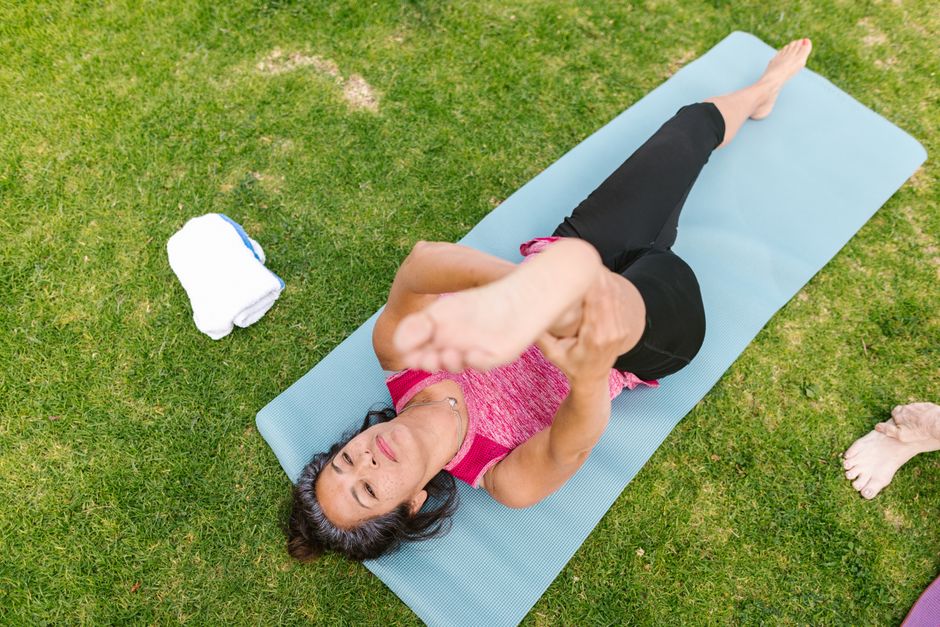
This routine focuses on the muscles that support the knee: the quadriceps, hamstrings, glutes, and hip abductors. No equipment required. Do this on 3 non-consecutive days per week to start.
1. Supine Quad Set
Lie on your back with both legs straight. Tighten the quadriceps of one leg by pressing the back of your knee gently toward the floor. Hold for 5 seconds. Release. Do 10 repetitions per leg. This activates the VMO (vastus medialis oblique), the teardrop-shaped muscle above the inner knee that tends to weaken quickly with knee pain.
2. Straight Leg Raise
Still lying down, bend your uninvolved knee to 90 degrees with your foot flat on the floor. Keep the working leg straight and lift it to the height of your opposite knee. Hold 2 seconds at the top, lower slowly. Do 10 to 15 repetitions per leg. This builds quad strength without any knee joint compression.
3. Side-Lying Hip Abduction
Lie on your side with your hips stacked. Keeping your top leg straight and your toes pointed slightly down, raise it to about 45 degrees. Lower with control. Do 12 to 15 repetitions per side. Strong hip abductors reduce the inward collapse of the knee during any weight-bearing activity, which is one of the primary mechanical causes of knee pain.
4. Glute Bridge
Lie on your back with both knees bent and feet flat on the floor, hip-width apart. Press through your heels and lift your hips until your body forms a straight line from shoulders to knees. Hold 2 seconds at the top, lower slowly. Do 10 to 15 repetitions. The glutes do an enormous amount of work protecting the knee from above, and they’re consistently undertrained in people who’ve been living with knee pain for years.
5. Seated Knee Extension (Short Arc)
Sit in a chair and place a rolled towel under one knee to hold it at a slight bend. Straighten that leg until it’s fully extended, hold 2 seconds, lower slowly. Do 10 repetitions per leg. This targets the quad through a pain-free range for most people, unlike a full leg extension machine which can aggravate the knee at certain angles.
Rest 60 seconds between exercises. Total time is about 20 minutes. Add the pool, bike, or walking sessions on top of this as your tolerance allows.
What to Avoid (and Why These Mistakes Are So Common)
A few exercises appear on “bad knee” workout lists constantly. They shouldn’t.
Deep squats and lunges are the main offenders. Full-depth squatting creates that 7 to 8x body weight force I mentioned earlier, and for someone with bone-on-bone osteoarthritis or a history of meniscal tears, that’s genuinely risky. Shallow squats to a chair (essentially a sit-to-stand with control) are different and can be very beneficial. But the “just go deeper” cue that’s popular in general fitness has no place here.
High-step stair climbing machines are another one to skip. The steep knee flexion angle, combined with the resistance load and repetitive impact, is hard on cartilage and the patellofemoral joint (the kneecap). Elliptical trainers are generally much better, but even there, some people find that the fixed stride length creates an uncomfortable torque. Pay attention to how your knee feels during and for 24 hours after any new exercise. That 24-hour window is important: sometimes inflammation from overloading doesn’t peak until the next day.
The Role of Strength Training Beyond the Basics
Sources
- here is mixed when it comes to which specific exercise is “best
- has consistently shown that quad weakness is both a predictor and a consequence
Here’s something the “gentle stretching only” crowd often gets wrong. Strength training, done correctly, is one of the most protective things an older adult with bad knees can do. The quadriceps specifically act as a shock absorber for the knee joint. Every pound of quad strength you build reduces joint load during walking. Research has consistently shown that quad weakness is both a predictor and a consequence of knee osteoarthritis progression.
The evidence on progressive resistance training for older adults with knee pain is genuinely encouraging. A Cochrane review of 54 trials found that land-based exercise (which includes strength training) significantly reduced pain and improved physical function in knee osteoarthritis. The effect sizes are modest but real, and they accumulate over time.
What surprises many of my clients is that they can start building meaningful strength without ever loading the knee in a painful position. The seated and supine exercises in the routine above are your on-ramp. Once those feel manageable, you can progress to standing work with support: chair-assisted shallow squats, step-ups to a low step, and terminal knee extensions with a resistance band. Always clear new exercises with your physical therapist or physician first, especially if you’ve had recent surgery or significant structural damage.
The bottom line is that bad knees don’t have to mean a smaller, more sedentary life. The path forward is usually more movement, not less, but movement that’s chosen deliberately and progressed carefully. Start where you are. Build consistently. And if you’re not sure where your knee falls on the spectrum between “needs gentle rehab” and “needs medical intervention first,” please talk to your doctor or a licensed physical therapist before starting a new program. Getting that baseline assessment isn’t over-cautious. It’s just smart.
This article is for general informational purposes only and does not constitute medical or fitness advice. Consult your physician or a licensed physical therapist before starting a new exercise program, especially if you have existing health conditions.